Ebook
eBook paper - Document Management: What are the key aspects to achieve successful construction projects?



Even the smallest construction projects rely on contracts to capture the scope and terms in a legally binding agreement. As the industry has evolved, the different construction contract types have grown from a single document outlining all details to a collection of interrelated documents that solidify the initial scope, cost, and schedule—yet these are likely to change throughout the course of the project.
The word “contract” often recalls long and complex documents that are difficult to read and bring little or no value. For construction projects with large budgets and important interdependencies, contract documents are anything but a formality since they collectively define critical deliverables and expectations. There are many other reasons why contract documents in construction are important:
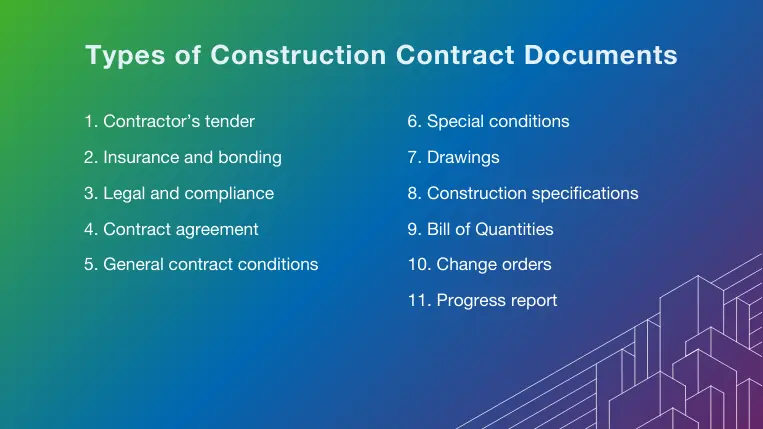
Construction contracts, especially for large projects, cover too much ground to be contained in one document. As the industry has evolved, contracts have been organized into a collection of many individual documents that each serve a unique purpose. The number and type of documents vary, but many categories of documents are commonly included in the scope.
The initial tender submitted in response to a bid invitation is one of the first and most essential contractor documents. The tender defines the price, schedule, payment terms, and approach to be followed by the contractor. This information is woven into the formal contract terms after the bid is accepted.
Information on the insurance policies held by construction business owners involved in the project is another important element. These policies should include:
Bonds should also be in evidence to prove that each contractor or construction business is compliant with relevant laws and regulations and can take financial responsibility if they fail to deliver the services agreed to in the contract.
The list of contract documents also includes permits and licenses that demonstrate compliance and prevent legal issues. Documents in this category include zoning approvals, building permits, environmental clearances, and trade-specific licenses for subcontractors. These documents should be readily available for inspections and audits, a big part of a successful construction document management strategy.
The contract agreement is the centerpiece of the overall package and includes a summary of important terms and conditions established to govern the construction process. The agreement also references the other documents and addendums. When both parties sign this central agreement, it acts as an approval for all the referenced documents in the package.
This document includes a framework for the rights, responsibilities, and obligations of the client (owner) and contractors. Subcontractors and consultants might also be included in the scope. The scope of work (SOW), terms for handling unforeseen site conditions, and inspection procedures are frequently cited as contract conditions.
General conditions cover most standard legal and procedural aspects of the project. Still, an additional document may be required to cover special conditions, including unusual materials, building codes, or regulations, such as green building standards. Special permits, approvals, and warranties might also be captured under special conditions.
The construction architect uses drawings to present the design intent in fine detail and document the expected project results using dimensions, visualizations, and spatial relationships. Drawing packages can include hundreds or even thousands of pages for large projects. These are essential contract documents since they inform the construction team about executing the work while providing a baseline for contract fulfillment verification.
Much like drawings, construction specifications are among the contract documents used to convey project-specific information like material types, workmanship standards, and quality requirements. Specifications complement drawings by layering material, process, and safety requirements onto the basic 2- or 3-dimensional drawing information. Detailed specifications generated by a professional construction specifier also provide a basis for cost estimation and bidding.
A Bill of Quantities (BoQ) is a document that lists the number of work items required to complete the project. The BoQ includes descriptions and unit of measure (UOM) information for each item so that it can be handed over to contractors to complete their tender documentation efficiently. The BoQ also provides transparency to help calibrate client and contractor expectations.
When significant changes to the design specification or scope are necessary, they must be incorporated into the contract using change orders. A change order is a legal agreement between the client and contractor regarding the new scope of work to be performed and any associated price adjustments.
Formal updates on project status, including tasks completed, comparisons to the schedule, labor and material utilization, and budget conformance, are also important construction contract documents. Implementing a construction reporting system to track progress regularly also helps maintain accountability throughout the project.
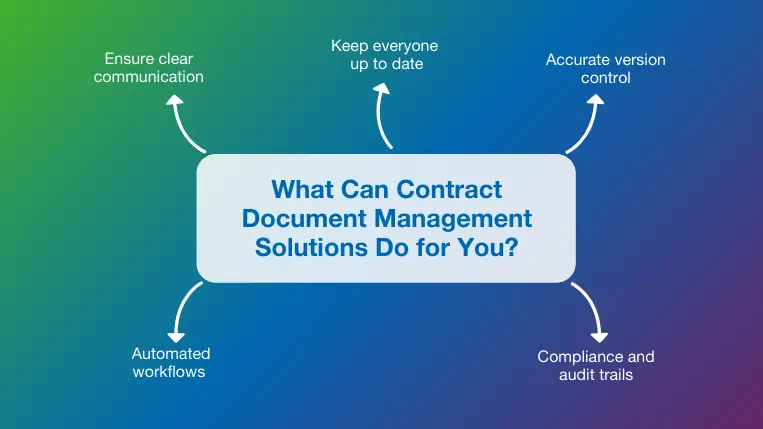
Managing thousands of pages and dozens of individual contract documents in construction can be time-consuming and tedious, but clarity and accuracy remain essential. Construction document management software makes it easier to maintain these files while safeguarding the project’s interests by providing several key benefits.
These solutions improve communication and collaboration in construction projects by providing a centralized, searchable database for all important documents. This ensures contractors, clients, subcontractors, quantity surveyors, and other stakeholders are reviewing the same information, and miscommunication is minimal. Contract management solutions also keep these voluminous files organized so they can be located more easily.
A centralized digital repository with features like automated alerts, revision tracking, and integrated dashboards ensures everyone reviewing contract documents has access to the latest files and is informed as needed when files are added or changed. This helps to eliminate confusion over the relevance and currency of documents that can cause delays or disagreements.
Document management software helps to ensure that the contents of a contract are maintained under strict version control by continuously tracking and archiving obsolete documents. These systems allow stakeholders easy access to the latest iterations while moving outdated elements to protected digital file locations. Version control is essential for both accuracy and compliance.
Organized, version-controlled contract documents improve visibility and communication, but they also contribute to an audit trail essential for maintaining compliance with industry regulations and safety standards. The audit trail will also include details like the names of stakeholders who accessed each document, and the precise dates and times files were updated, added, or removed.
Even with software tools to store and organize files, version updates, approvals, and notifications can quickly become cumbersome without automation to streamline the process. Automated workflows to route documents for approval, send alerts, and distribute new files minimize manual processes and improve efficiency. They also reduce potential errors or oversights that can lead to delays.
The volume and diversity of construction contract documents can be challenging. Still, they are necessary to ensure all essential terms, design features, and schedule expectations are clearly stated and agreed upon.
RIB’s innovative toolkit of construction software solutions simplifies the contract management process with industry-leading tools to support centralized communication, streamlined document management, advanced scheduling, and integrated change control and estimation processes. If you are ready to benefit from state-of-the-art construction document management software and reap the rewards of accessibility and collaboration, get your free demo of RIB’s toolkit today!

Ebook

Construction cost estimation is the foundation upon which projects in the construction industry are created. These careful computations dictate timeframes,...

One of the major challenges in construction project management is that productivity is not improving as rapidly as the industry...

RIB Software’s Jared Halbert, Senior Consultant, looks at why the right digital framework is essential for sustained, sustainable construction For...