Ebook
RIB CostX eBook - The Ultimate Estimating Solution



The construction industry is a vital part of the Australian economy, typically accounting for around 9% of the country’s GDP. This massive, thriving industry comprises thousands of companies that bring to life the residential buildings, bridges, hospitals, schools, and airports Australians populate daily - despite global economic uncertainty and ongoing skilled labor shortages.
Knowing how leading players are evolving and implementing digital solutions to succeed in challenging times is fundamental to understanding the industry’s future. To that end, we’ve put together this list of the top 10 construction companies in Australia plus a short overview of the industry’s current state.
Let’s dive in!
The construction industry continues to be a key contributor to the Australian economy, with a market size of USD 173 billion (AUD 244 billion) in 2026. Almost 1.4 million people across the country are employed across various construction sectors, as the rising national population increases demand for housing and infrastructure.
As construction companies in Australia continue to shift towards modern methods and software tools, the industry is projected to grow at a rate of 4.1% CAGR (compound annual growth rate) through 2031. To compensate for the country-wide labor shortage and improve efficiency, modular construction, including prefabricated homes and building elements, is expected to grow by almost 8% CAGR during the same five-year span. This trend will help offset the high demand for energy-efficient construction designs and methods that can often be completed more easily off site.
Much like the US, UK, and other parts of the developed world, emerging digital technologies are significantly impacting Australia. Continued adoption of Building Information Modeling (BIM) and sustainable construction practices will improve project quality and efficiency as the activity ramps up. These advanced tools will also be needed to support a growing pipeline of major infrastructure and transportation projects supported by government funding.
Despite the temporary decline witnessed over the past several years, expansion in multiple sectors has seen the total number of construction companies in Australia in 2026 rise to 440,000, according to independent IBISWorld research. With so many successful businesses operating today, choosing the top construction companies in Australia was no easy task.
Each year, Mordor Intelligence reviews Australian companies based on market share, revenue, repeat client momentum, carbon reduction, and other key factors. Not surprisingly, many of the top construction companies in Australia are also rated highly by their employees. This synergy allowed us to create a relevant top 10 list for 2026 that emphasizes the common traits found in the leading construction players today.
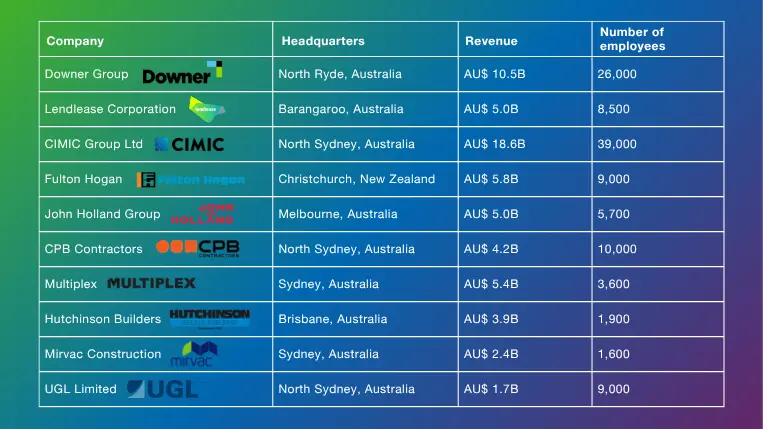
Our list of construction companies in Australia starts with a major player: the Downer Group. With a reported revenue of 7.5 billion USD (10.5 billion AUD) and over 26,000 employees, Downer designs, builds, and maintains infrastructure and facilities across Australia and New Zealand, putting employee safety and sustainability first.
The company offers solutions for several sectors: transport and infrastructure, rail and transit, power and gas, energy, telecommunications, defense, and healthcare. Among the group’s most successful projects are the voltage transmission line connecting the South Australian and New South Wales power grids, the infrastructure upgrades to the Air Force’s RAAF Base in Williamtown, and the Murra Warra Wind Farm in Victoria, among various others that have earned this company decades of success.
With over 65 years of experience, Lendlease Corporation has made it their goal to reshape cities, create connected communities, and deliver the workspaces of the future. A three-tiered business model, including investment, development, and construction has made award-winning projects like Singapore’s Paya Lebar Quarter, New York’s Claremont Hall, and the Barangaroo Precinct in Sydney possible.
Lendlease was founded in 1958 and eventually expanded operations to the US, Asia, and the UK. The company is known throughout the construction industry as a top developer of urban infrastructure. It is also a key priority for Lendlease to establish sustainable economic growth imperatives. The company currently uses 100% renewable electricity for all operations to help them achieve their Net Zero Carbon targets, with a goal of Absolute Zero Carbon by 2040.
Founded in 1899, CIMIC Group is one of the largest and most diversified construction companies in Australia, with subsidiaries operating in the mining, infrastructure, and renewable energy spaces, among others. CIMIC has built a solid reputation by delivering large-scale, sustainable solutions with exceptional quality and reliability.
All 39,000 CIMIC employees abide by the guiding principles of integrity, accountability, innovation, and delivery. Dedication to these core values is witnessed through the success of recent projects, including the New Bundaberg Hospital in Queensland, the Burnett River Replacement Dam, and the Macarthur Wind Farm in Victoria. CIMIC also maintains a strong global presence with ongoing projects in Europe, Asia, and the Americas.
Subsidiaries under the CIMIC umbrella of companies, including CPB Contractors, Theiss, and UGL, have become industry leaders in their respective fields, owed in large part to the strong overall company mission.
Another business consistently ranked among the top construction companies in Australia is Fulton Hogan. A prominent infrastructure, civil engineering, and road construction company with operations also in New Zealand, Fulton Hogan specializes in enhanced connectivity between geographic locations.
Jules Fulton and Bob Hogan teamed up 93 years ago to form their contracting business, and now the company employs over 9,000 people across the region, with annual revenue exceeding USD 4.9 billion (AUD 6.8 billion). Key projects in recent years have included the Mount Ousley Interchange in Wollongong, the Hallam Bypass in Victoria, and the 56-turbine Bulgana Wind Farm in Western Victoria.
Along with an ownership stake in the business, commitment to sustainability is a commodity shared by many dedicated Fulton Hogan employees. The company promotes sustainable practices throughout its supply chain while leveraging digital technologies to reduce its carbon footprint.
Notable projects led by the John Holland Group dot the Australian landscape, including the Parliament House in Canberra, the Sydney Football Stadium, and the 246-meter Batemans Bay Bridge, spanning the Clyde River in New South Wales. Since its founding in 1949, the company has built a portfolio of successful transportation, energy, and social infrastructure achievements.
John Holland Group has over 5,700 employees worldwide, with annual revenue exceeding USD 4.3 billion (AUD 6 billion). The company has been the recipient of numerous industry awards for excellence in urban development, water conservation, and railway construction, as well as being recognized by the Indigenous Chamber of Commerce (ICC) and National Association of Women in Construction (NAWIC) for their progressive social values.
John Holland Group was acquired by China Communications Construction (CCC) in 2015, making it part of one of the largest construction conglomerates in the world, while providing greater access to global resources and expertise.
As a key component of CIMIC Group, CPB Contractors specializes in major infrastructure and building projects, specifically those involving complex transportation, tunneling, water management, or renewable energy. CPB traces its origins back to 1927, with large-scale railway and tunneling projects in the 1940s and 1950s helping to solidify the company’s reputation for technical expertise and project management in construction.
Recent projects completed by CPB include the new Notre Dame College in Queensland, the Metro Railway Tunnel in Melbourne, and the 420-Megawatt Macarthur Wind Farm in Victoria. Ongoing projects include the CopperString 2032 high-voltage transmission network in Queensland, designed to improve energy transmission, cost, and safety. These new projects emphasize sustainability principles that extend to clients and local ecosystems, and community-based initiatives that add long-term economic and social value.
As one of the biggest construction companies in Australia, Multiplex has delivered over 1,150 iconic projects around the world, with a combined value exceeding USD 130 billion (AUD 182 billion). Since establishing their company headquarters in Sydney in 1962, Multiplex has opened offices in the Middle East, UK, and Canada.
Past projects span the commercial, residential, health, and education sectors, with a focus on sustainability and high quality. Recent accomplishments include the 12-story, 180,000m2 Footscray Hospital in Victoria, and the OmnioBio Research and Innovation Park in southwestern Ontario. Both projects showcase an ability to complete large and complex industrial facilities while adhering to strict budgets and timelines.
Multiplex currently employs approximately 3,600 people around the world who help them develop the innovative construction techniques the company is known for. Multiplex is also dedicated to maintaining a culture of construction project collaboration and trust with their industry partners.
Established in 1912, Hutchinson Builders is country’s largest privately owned construction company. Also known as “Hutchies,” the company was founded in Sydney by John “Jack” Hutchinson, a native of England with a passion for hard work, family, and challenging construction projects. The company currently boasts over USD 2.4 billion (AUD 3.3 billion) in annual revenue, with more than 1,900 dedicated employees.
Hutchinson Builders established their reputation through commercial, healthcare, and educational contracts spanning over a century. This trend has continued into the present day, with projects such as the Fortitude Valley State College in Queensland and Cobar Health Service in New South Wales, evincing unmatched building expertise and project execution.
Like many other public and local private construction businesses, Hutchies has adopted a set of sustainable values that benefit both the environment and the community. This includes the formation of Hutchinson Honey Bees, a unique initiative dedicated to promoting the establishment of urban bee hives on a national scale.
The next entry in our list of top construction companies in Australia is Mirvac Construction, a unique property development, leasing, and management company with a reputation for combining sustainable design and architecture with smart business and investment. Mirvac has been the recipient of over 800 industry awards since its founding in 1972.
The company has made its mark primarily through the development of master-planned communities, including the 300-unit Riverlands development near downtown Sydney and the stunning Albertine complex in Victoria. Mirvac has also overseen the development of renowned retail developments throughout the country, including Broadway Sydney and Birkenhead Brand Outlet.
The team of over 1,600 dedicated workers at Mirvac enjoy a culture that emphasizes environmental health and safety, social equality, and environmental sustainability. The company reached their ambitious net positive carbon (scope 1 and 2) goal in fiscal year 2022.
Last (but not least) on our list of construction companies in Australia, UGL is also the second subsidiary of CIMIC to catch our attention. UGL Limited has established a unique specialty within the larger company by focusing on end-to-end engineering services. The broad scope of expertise also includes infrastructure commissioning, asset management, and facility upgrades.
The company was founded by Alfred Goninan in 1899 to support the local coal wagon industry. After playing a key role in Australia’s public transport industry for over a century, the current company name, United Group Limited (UGL) was adopted in 2012. Under this banner, noteworthy projects have included Canberra Light Rail and the design and construction of numerous renewable energy facilities, including the 88-megawatt Dugald River Solar Farm in Queensland.
A healthy pipeline of new and challenging engineering projects keeps over 9,000 UGL employees, in six locations, occupied and engaged.
Some of the most frequently asked questions on Australian construction cover the state of the industry in 2026 and the important traits shared by the top 10 players.
With revenue of AUD 16.8 billion in 2025, and almost 40,000 dedicated employees, CIMIC Group has moved ahead of Downer Group and Lendlease on the list of the biggest construction companies in Australia. Large infrastructure projects and the mining boom have been key growth factors for CIMIC Group, along with the increased demand for renewable energy projects in Australia and other countries where CIMIC has a strong presence.
While IBISWorld research estimates the number to be approximately 440,000 companies, other reliable sources, such as the Reserve Bank of Australia, provide slightly smaller (410,000) figures. The vast majority (98.5%) of these companies are small businesses with fewer than 20 employees.
The pace of new construction company formation has been impressive in recent years. Over 76,000 new construction businesses were established in 2025 alone, which was the highest total across all industries in Australia. A boom in infrastructure projects, tax incentives, and increased specialization provide each new construction company in Australia with a chance to endure and thrive.
The complexity of modern infrastructure construction, housing, and commercial construction projects makes modern software tools essential for the top construction companies in Australia. This includes building information modeling (BIM) platforms that move key design, planning, material management, and sustainability elements into the digital realm. Cloud-based estimation, construction scheduling, and reporting tools are also a must for firms with large project footprints and dispersed teams.
RIB Software solutions for planning and design, construction document management, and embodied carbon tracking allow innovative companies to weave a digital thread through their organizations, while delivering sustainable projects on time and on budget.
Identifying the best place to work depends on the specific skills and preferences of the individual construction professional. Major cities like Sydney and Melbourne offer consistent work and high wages, while Queensland, Western, and South Australia have seen a steady stream of infrastructure and renewable energy projects in recent years.
Upcoming events such as the 2032 Olympics in Queensland, along with large residential projects across the nation, will provide reliable sources of employment over the next decade. Queensland alone currently has a shortage of approximately 50,000 construction workers, with unprecedented demand for talented carpenters, site managers, and electricians.
The construction industry in Australia is led by some impressive firms with decades or, in some cases, centuries of experience developing infrastructure for local communities. Technology is the fuel that powers that success, providing these organizations with the necessary tools to streamline operations and go the extra mile.
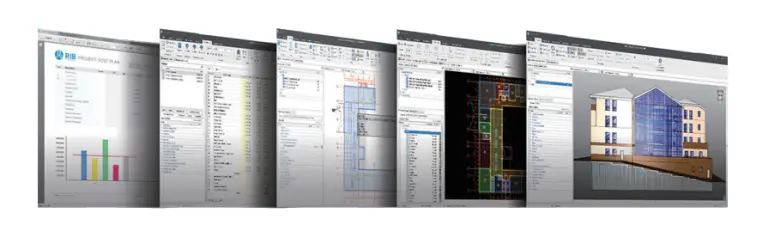
RIB Software has designed a specialized toolkit of solutions tailored to the needs of construction businesses, with platforms connecting 3D takeoff, project management, financial management, procurement, project handover, and many other capabilities. Powered by professional digital construction technologies, these capabilities have positioned RIB as a leading provider of software solutions for the global building industry. RIB’s CostX offers professional takeoff and estimating software with unmatched levels of precision and speed that helps eliminate errors from estimating, and ensures that construction projects are priced accurately for increased profitability and success.
Set your construction firm apart from the competition with quality and efficiency - get your free RIB CostX demo now.

Construction cost estimation is the foundation upon which projects in the construction industry are created. These careful computations dictate timeframes,...
One of the major challenges in construction project management is that productivity is not improving as rapidly as the industry...

RIB Software’s Jared Halbert, Senior Consultant, looks at why the right digital framework is essential for sustained, sustainable construction For...