Ebook
Future-Proof Your Construction Business


The construction industry is a massive sector with many moving parts. Navigating the range of people, processes, and tools involved in the industry on a daily basis can be a bit of a challenge, especially for someone with little to no background in construction.
A good starting point is to understand that there is a variety of construction services and companies with different offerings that reflect the varied and complex demands of construction projects. To help you understand how this massive industry really works, we’ve put together this outline of the most prominent types of construction businesses and services, detailing the part each plays in bringing projects to life.
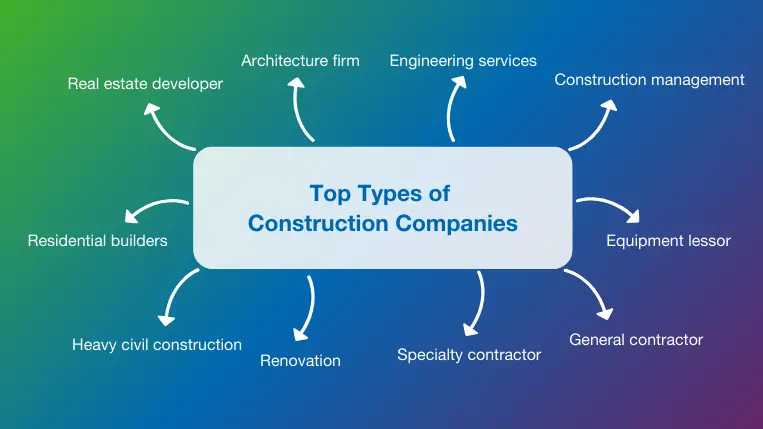
We’ve broken down the different types of construction companies to help you decide who to hire to fulfill a particular part of a project or if you’re considering a career in construction, or simply want to know more about the industry.
A real estate developer’s primary mission is to build and market a project, often large-scale, to profit from it. Their process involves buying a property, securing financing, obtaining permits and approvals, hiring a design team, and overseeing project development. In most cases, the real estate developer is the property owner. However, a property owner can sometimes hire a development business to handle the project due to its expertise and contacts.
The developer begins the land acquisition process with market research to determine the best properties to buy and develop, followed by the navigation of zoning laws, then working with architects and engineers to ensure new development projects are carried out successfully. Depending on the structure and preferences of the business, they may be heavily involved with construction oversight, or delegate this responsibility to contractors. Selling fully developed properties to an investor or future occupants is the final stage of the real estate development process.
An architectural or design firm is responsible for developing a project’s drawings and design specifications. They are often hired by the real estate firm or the project owner to assist in the design process. These firms sometimes also take on a management role, hire general and specialty contractors, and take care of the payments as part of their service. Architectural firms often specialize in areas like urban planning, commercial buildings, or residential construction.
Skilled architects and designers are employed by these firms to utilize their creativity and technical skills to meet client needs. This usually begins with conceptual drawings or basic 3D models to convey their ideas, with the designs, drawing sets, and specification continuing to develop as the project progresses. Some architectural firms also offer consulting services to advise clients on issues like project feasibility, sustainability, and code compliance.
An engineering firm is hired to work in collaboration with the design team to bring a project to life. Their knowledge and expertise help to ensure that the design complies with building codes, safety regulations, and site-specific conditions. They also assist in testing different strategies and technologies to ensure successful completion. These firms bridge the gap between the architectural design and physical construction by evaluating and improving the structural integrity of a build or infrastructure construction project, and performing advanced analysis to identify weaknesses.
Additional areas of specialized engineering services include seismic (earthquake protection) firms, materials science consultants, geotechnical (soil and rock) experts, transportation engineering, and sustainable construction specialists. Engineering services are valuable assets on projects with unique requirements or challenging design considerations.
As the name suggests, a construction management company offers services to support the complete management of a project. This involves hiring all the staff, including the project manager, general contractor, and specialty contractors. Depending on the involvement and preferences of the client, the construction management firm might also be given responsibility for scheduling, budget creation, and quality management activities on the project.They are often in charge of contractor management and payments.
This type of service is utilized for complex projects that require extensive teams. Construction management firms often work closely with architects, engineers, and contractors as they collaborate to bring information from the field to the office for review and analysis. Retaining a full-time construction manager allows the client to take a less active role, as these firms take over most day-to-day site and project management tasks.
Some construction firms have their own machines and equipment. However, some projects need more complex equipment that may be too expensive to buy - it makes better business sense to rent from an equipment lessor company. Equipment companies rent and often take care of transporting the machinery to a building site at an agreed time and date. They sometimes also provide the personnel to handle the machines.
Equipment companies can be smaller firms that rent or sell tools and powered equipment to contractors and consumers for personal use, or large businesses that provide heavy equipment like cranes, excavators, and loaders to construction companies to lease. Some of these businesses also offer used equipment for sale at a more affordable price. Much of this equipment requires specialized licensing to operate, and can cost over USD $1 million to purchase new, which makes these types of construction services essential for fast-moving construction project teams.
A construction general contractor may be hired to manage a project’s construction phase where the owner of a smaller project doesn’t need a construction management company. The GC company and its team collaborate with the project manager and design team to ensure all specifications are respected to avoid costly reworks. They are responsible for subcontractor management, which includes hiring subcontractors, coordinating their schedules, and paying them according to agreed contract terms. The GC is likely to be the central point of contact, which means they play a key role in resolving problems and conflicts.
A GC helps to develop project budgets, and works with construction estimators and quantity surveyors to ensure all costs are properly accounted for. Additional responsibilities include securing permits and approvals, ensuring safety practices are maintained, and interpreting drawings and blueprints in the field. General contractors enjoy a certain amount of freedom and flexibility with their small, independent business.
Specialty contractors offer highly focused services that meet specific project needs regarding materials, equipment, regulatory standards, or techniques. They are often hired by a general contractor or the entity in charge of the project. While some specialty contractors are sole proprietors, others can form a small business consisting of other experts in the same field.
Most specialty contractors only offer one type of service, with carpentry, roofing, plumbing, painting, and masonry being among the most common and well-known. This specialization allows them to develop a high level of expertise, focusing exclusively on the task at hand as one of many specialists on a busy job site.
Construction projects come in all shapes and sizes. Sometimes, it’s about building a huge and complex project, and sometimes it’s just about renovating a specific room or area within an existing structure. A renovation firm is hired for their expertise in the latter type of project. Renovation companies often deal directly with the project owner and bring in their own team and materials. The key difference between renovation businesses and other contractors or subcontractors is the specialization in cosmetic updates, remodels, and rebuilds, rather than ground-up construction.
Special considerations for renovation companies include waste removal, structural integrity, and safety during selective demolition and rebuilding, and liability insurance to cover any accidents or unforeseen issues. They also take responsibility for a wide variety of design, carpentry, plumbing, and finishing activities - they sometimes contract out selected tasks to other specialists.
Heavy civil construction firms oversee building complex infrastructures that are essential for communities to function, including bridges, railroads, roadways, ports, and tunnels, among others. They require a high level of experience in civil engineering, legal permits, and sustainable construction.
Some heavy civil construction operations are challenging to complete, including large-scale earth moving, mass excavation, complex concrete work, and hazardous underground tasks. Some businesses in this category specialize in marine operations, which entails utilizing large dredging, pipe-laying, and underwater welding equipment under extremely challenging conditions.
Residential builder businesses have particular expertise in developing living spaces for people, like houses or apartment complexes. They focus on more than just erecting structures. They create environments where communities can develop and, therefore, need to understand local zoning laws and landscape design. Residential builders are responsible for all facets of a new project, from construction planning and design to permitting, site supervision, and quality control.
These companies must spend time obtaining the necessary permits to ensure compliance, and hiring skilled workers to complete interior and exterior work on new homes or apartments. Residential builders have benefited from high demand and steady work in recent years, with the risk of cost overruns and unforeseen material or construction issues reduced by the repetitive nature of the projects.
As digital tools and technology develop, and utilization becomes more widespread, the various roles and responsibilities across construction become more diverse and specialized. Let’s focus on some of the most frequently asked questions about the types of construction services.
Profitability and growth are key objectives for almost all businesses, and the construction industry is no exception. Traditionally, companies with the highest level of demand and the most complex projects have been the most profitable. The current shortage of skilled workers in the specialty trades, along with industry growth in many parts of the world, has made small subcontractor businesses like HVAC, electrical, and plumbing extremely profitable. Companies specializing in high-end buildings and large infrastructure projects are also seeing substantial profit margins.
New technology and environmental concerns are changing the industry quickly, and this is apparent among emerging construction businesses over recent years. This includes companies offering building information modeling (BIM) platforms or BIM construction management and training, construction management software tools, advanced drones, and robotics now used for site grading and bricklaying. Construction businesses and consultants focused on sustainable building practices, “smart” building integration activities, and modular (off-site) construction are also seeing exceptional growth as these methods become more mainstream and demand increases year after year.
The construction labor shortage has benefited some specialty trades, especially those workers with unique skills, specialized training, and high demand. Elevator installers currently earn the highest wages of any paid trade, with a median annual salary of over $105,000 in the US. These experts must understand electrical, mechanical, and computer principles to install and repair elevators safely. Other well-paid trades include plumbers, pipefitters, HVAC technicians, and wind turbine technicians focused on sustainable construction. Wages for these roles are expected to remain high as the demand increases and older workers retire.
A design-build company operates on a slightly different model than traditional builders as they handle all architectural, design, and construction services under one roof. This provides added convenience for clients and streamlined construction communication throughout the project. On the other hand, the design-build model locks the owner into a single-company contract, rather than allowing them to pursue the best possible option for each element or phase. Despite the potential drawbacks, design-build contracts are growing in popularity as these companies develop expertise in all facets of the industry.
Given the wide variety of construction businesses in the market, tailored to the different needs of the industry, learning what role each of these organizations plays will bring you a step closer to understanding the intricacies of the building industry.
Among the different types of construction companies, we see experts in their field who have a special responsibility in bringing the structures we inhabit and use daily into functional existence. To execute their responsibilities, tasks, and activities successfully, they leverage technology, keeping pace with construction trends to ensure that their resources are spent smartly and efficiently.
RIB Software is a leading provider of construction software solutions designed to support all types of construction businesses, from owners to engineers, architects to contractors, and more, in delivering projects with the highest quality and accuracy. Innovative technology and expertise from decades of experience in construction combine to offer a working partnership that can help boost the profitability of your projects. Get your free demo of RIB Software now!

Construction cost estimation is the foundation upon which projects in the construction industry are created. These careful computations dictate timeframes,...
One of the major challenges in construction project management is that productivity is not improving as rapidly as the industry...
RIB Software’s Jared Halbert, Senior Consultant, looks at why the right digital framework is essential for sustained, sustainable construction For...