
Ebook
RIB CostX eBook - The Ultimate Estimating Solution


Over the past decade, business intelligence has exploded. Data has become gigantic, and just like that, we all gained access to the cloud. Spreadsheets finally took a backseat to actionable and insightful data visualizations and interactive business dashboards. The rise of self-service analytics democratized the data product chain. Suddenly, advanced analytics isn’t only for analysts.
2025 was a banner year for the business intelligence industry. The trends we presented last year will continue to play out through 2026. However, the BI landscape is evolving, and the future of business intelligence is happening right now, with emerging trends to watch. In 2026, BI tools and strategies will become increasingly customized. Businesses of all sizes are no longer asking if they need increased access to business intelligence analytics, but what is the best BI solution for their specific needs?
Businesses are no longer wondering if visualizations improve analyses but what the best way to tell each data story is, especially with the help of modern BI dashboard software. 2026 will be the year of data security and discovery: clean and secure data combined with a simple and powerful presentation. It will also be another year of collaborative BI and AI, where multiple industries will dive into analytics to benefit from the power of data, such as the case of construction business intelligence, which we will discuss in detail later in the post.
We are excited to see what this new year will bring. Read on to see our top 10 business intelligence trends for 2026!
As mentioned in the introduction, construction is one of the many industries that has jumped onto the BI train and benefited from advanced analytics. The construction case is interesting because this massive industry has always been recognized as reluctant to change, probably because it is one of the oldest industries in the world, with processes that have been tested repeatedly with positive results, at least until now. However, as the world becomes more digitally driven, the construction industry must keep up with changes. In 2026, we can expect an even greater adoption of digital construction technologies, like building information modelling (BIM), artificial intelligence (AI), digital twins, IoT sensors, and other innovations, that will drive the industry forward.
Construction analytics can solve many challenges for companies in the building sector, including disparate data sources, outdated reporting, and decentralized teams and systems. These issues lead to costly errors that make projects longer and more expensive. By integrating more data management and analytics practices and technologies into their workflows, construction companies can leverage real-time data to make projects more time and cost-efficient from preconstruction planning to completion and handover.
This is possible with the support of professional BI software, which offers a centralized location to aggregate data from multiple sources and visualize it in interactive construction reports that anyone can access and understand. Plus, many processes once done manually, like a quantity takeoff or a bill of quantities, can now be automated, saving teams hours of work and significantly reducing the risks of manual errors. Construction analytics also make it possible to track sustainability metrics like embodied carbon, energy consumption and material reuse throughout the project lifespan.
That being said, the benefits are not purely operational. From a teamwork perspective, implementing analytics can also be a significant driver of productivity. It is no secret that collaboration and communication in construction projects have always been a challenge. With project stakeholders working from different locations, it is common for communication barriers to bring costly misunderstandings and errors. The proper construction analytics software can easily solve this issue by offering 24/7 access to real-time data in an online environment. This means anyone, regardless of device or location, can access and share the data with others to collaborate and communicate, ensuring everyone is working from a single source of truth.
However, adopting new software and practices is not easy. Leaders in the building industry must continue to implement well-thought-out construction change management strategies to ensure the process goes smoothly. Involving all employees in the process can boost engagement and make it more effective.
2026 is shaping up to be an exciting year for the building sector. As the importance of construction project management grows, industry leaders need to invest in technology that will boost teamwork and modernize processes that can no longer be carried out manually. We look forward to seeing it happen!
Artificial intelligence (AI) is the science and technology that enables computers and machines to simulate human learning, decision making, and problem solving, with or without human oversight. Often seen as the highest foe-friend of humans in movies (Skynet in Terminator, The Machines of Matrix, or the Master Control Program of Tron), AI has been met with a combination of enthusiasm, skepticism, and fear as the technology and capabilities improve faster than most experts had predicted.
While we work on programs and regulations to ensure applications are safe and beneficial, AI and machine learning are revolutionizing how we interact with analytics and data management systems. In addition, new security measures come into play as society becomes increasingly automated and dependent on AI to function.
It is expected that AI will evolve into a more responsible and scalable technology in the coming year as organizations will require a lot more from AI-based systems. According to Gartner’s Data and Analytics research for 2025, AI is becoming a “bet-the-business” skill set that is quickly changing how individuals work and is defining the success or failure of organizations. In change, these solutions will need to work with smaller datasets and more adaptive machine learning while also being compliant with new privacy regulations. Data management and analytics processes have been identified as the keys to bringing order out of chaos during this transition, along with the development of AI agents to access and share data across applications seamlessly.
Implementing systems and models to ensure the correct use of AI-related technologies will become even more important in the coming years. In fact, the US government released a blueprint for an “AI Bill of Rights,” presenting 5 principles that should guide the design, use, and deployment of automated systems “to protect the American public in the age of artificial intelligence.”
In response to this increasing need for AI accountability, Gartner presented AI TRiSM as one of the concepts that will help organizations ensure “AI model governance, trustworthiness, fairness, reliability, robustness, efficacy, and data protection.” This cross-functional framework must be implemented from the earliest stages of system design and involve people from compliance, legal, IT, and analytics for a successful approach. According to Gartner, businesses that apply this framework to their AI models are expected to be 50% more successful in adoption, business goals, and user acceptance.
The number of AI-based applications has become so big so fast that many IT professionals don’t even know how to use or interpret them. This leaves the door open for breaches and financial losses that can significantly impact companies and customers alike. As a response, terms such as explainable AI (XAI) will remain at the center of the conversation during 2026. XAI is an emerging field that aims to apply specific processes and methods to allow humans to understand the results and outputs created by machine learning and AI algorithms. The end goal of this field is to ensure trust and transparency needed to give humans full control over these systems.
When it comes to analytics, businesses are evolving from static, passive reports of things that have already happened to proactive analytics with dashboards that help them see what is happening at every second and give alerts when something is not how it should be. Solutions such as an AI algorithm based on the most advanced neural networks provide high accuracy in anomaly detection as it learns from historical trends and patterns. That way, any unexpected event will be immediately registered, and the system will notify the user.
Another feature that AI has to offer in BI solutions is the upscaled insights capability. It basically fully analyzes your dataset automatically without needing effort on your end. You choose the data source you want to analyze and the column/variable (for instance, revenue) the algorithm should focus on. Then, calculations will be run and come back to you with growth/trends/forecast, value driver, key segments correlations, anomalies, and what-if analysis. That is an incredible time gain as what is usually handled by a data scientist can now be performed by a tool, providing business users with access to high-quality insights and a better understanding of their information, even without a strong IT background.
Time gain is also present in the form of AI assistants. The latest trends in data and business intelligence include AI features that enable users to communicate with the software in plain language—in other words, the user types a question or request, and the AI generates the best possible answer.
The demand for real-time online data analysis software is increasing, and the arrival of the IoT (Internet of Things) also brings countless amounts of data, promoting statistical analysis and management at the top of the priority list. However, businesses today want to go further, and Adaptive AI might be the answer. As stated by Gartner, Adaptive AI systems “support a decision-making framework centered around making faster decisions while remaining flexible to adjust as issues arise.” These systems are so intriguing for companies today because they can learn from behavioral patterns and adjust to real-world changes, making it easier to make fast and improved decisions.
In that same realm, Generative AI is another technology that has revolutionized the industry in the past few years and will continue to do so in 2026. It basically enables AI systems to generate text, images, audio, and other types of content based on human-generated input. Perhaps the most well-known example of Generative AI today is ChatGPT. Launched in 2023, the tool revolutionized the industry with its ability to generate well-written texts based on a short input. However, as with many AI-related innovations, ChatGPT was quickly scrutinized because it could generate biases, copyright infringement, falsehoods, and more if not used ethically.
From a business perspective, using technologies like Adaptive and Generative AI has also made processes, including data collection, cleaning, and analysis necessary. AI tools are helping to automate and tailor these tools to the company’s needs. Risk management is another area in which these technologies thrive. Businesses can use Generative AI to predict any kind of fraud or attack, as well as generate risk simulations and test strategies in an imaginary scenario.
Agentic AI has also emerged as a valuable innovation for AI in business intelligence. It refers to systems and models that “can act autonomously to achieve goals without the need for constant human guidance.” This is a significant shift from existing rule-based AI models that cannot act independently. Agentic AI is programmed to achieve a goal and act on behalf of a human to achieve that goal. The technology harnesses the creative abilities of Generative AI but differs fundamentally as it does not focus on creating content but on making decisions. In 2026, Agentic AI is expected to improve human-machine collaboration due to its supercharged reasoning and, most of all, its advanced execution capabilities.
Overall, we cannot deny the value of AI and its continued development over the years. A recent study by IBM shows that companies are investing and adopting AI technologies to boost productivity and efficiency, with 77% of executives saying they need to adopt Generative AI quickly to keep up with competitors, and 63% stating that their AI portfolio will financially impact their organization in the next two years. Still, the process is not without challenges, especially when training employees or scaling existing IT infrastructures to support AI with the risk of technical debt. On top of that, regulators and decision-makers must ensure ethical and secure measures are imposed when implementing these systems. Ultimately, it all comes back to security; we will discuss it in more detail in our next trend.
As you have seen with our extensive AI trend, data and information security were hot topics in 2025 and will continue to be so in 2026. The implementation of privacy regulations such as the GDPR (General Data Protection Regulation) in the EU, the CCPA (California Consumer Privacy Act) in the USA, and the LGPD (General Personal Data Protection Law) in Brazil have established the foundation for data security and the management of customers’ personal information.
Moreover, the European Court of Justice’s overturn of the legal framework called Data Privacy Shield hasn’t made software companies’ lives much easier. The Shield enabled them to transfer data from the EU to the USA. Legal rulings back in 2020 invalidated the process, so companies with headquarters in the US no longer have the right to transfer EU data subjects.
Actually, a similar situation happened in 2015 when the EU and the USA had no legally valid agreements on this matter for a while. Many US-based (software) providers argued that they used European servers, so there was no data transfer to the US at all. However, from a legal perspective, even this solution is questionable, as, in theory, the US judiciary could force US-based businesses to reveal even data from EU-based servers. In essence, the information that is in the EU needs to stay in the EU. In practice, this means EU-based businesses that use it in the current situation and US-based software vendors that store any kind of data for them are taking hazards as they operate in a legal grey area.
Taking all this into account, businesses have been forced to invest in data security to stay compliant with the new regulations and also to protect themselves from cybercrimes. In fact, global spending on cybersecurity is expected to reach $500 billion by 2030. This is not a surprise to the experts since trends in business intelligence leaning toward cloud computing, hybrid and remote work, IoT expansion, and increasingly complex attack methods continue to add to the challenges each year. The advancements in AI have also left the door open to even more sophisticated attacks that require more refined levels of security. According to the 2024 KPMG CEO Outlook Pulse survey, cybersecurity is among the top “risks to growth” topics for CEOs in the coming years. Even more concerning is that only 54% of CEOs say their organization is prepared for a cyberattack, with 37% of them thinking they are unsure whether their current security systems can keep up with AI advancements and trends. Gartner predicts that by 2027, 17% of cyber-attacks will involve Generative AI, leaving organizations in a difficult position. That said, software developers still see this situation as an opportunity and will continue developing robust security solutions to tackle these challenges.
Luckily, with the current situation, company boards recognize cybersecurity as an overall business risk more than an IT-related issue. According to Gartner’s Cybersecurity Predictions for 2023-2024, by 2026, 70% of boards will include one member with cybersecurity expertise.
Amongst the measures organizations are taking in the coming years, we will see an increase in adopting the Zero Trust framework. Zero Trust doesn’t describe a specific technology, but an approach in which businesses remove the “implicit trust” from all computing infrastructure by verifying every stage of digital interaction from devices to users, regardless of location. This means every user who wants to interact with the company’s systems needs to be validated and verified. According to Gartner, by 2026, 10% of large enterprises will have a “comprehensible, mature and measurable” Zero Trust program in place, compared to the less than 1% that have one today. However, almost half of them might fail as a Zero Trust approach requires full organizational involvement and connection to business goals to succeed.
The concern in cybersecurity also presents a challenge for SaaS BI tools as they need to ensure they offer a secure product that clients will trust with their sensitive data. Like any other cloud BI solution, online business intelligence software is also subjected to security risks. Some of them include processing data quickly to provide real-time insights that might be subjected to regulatory compliance, vulnerabilities when moving data from user’s systems to the BI tool’s cloud, or when the tool provides access to data from multiple devices that may be unsafe and exposed to attacks. To prevent any of this from happening, BI software needs to have a clear focus on security.
Cybersecurity mesh architecture is one of the latest trends in business intelligence that helps SaaS BI solutions stay safe. Cybersecurity mesh is a composable and scalable security control that protects digital assets that reside in applications, in the cloud, IoT, and others. It seeks to establish a defined security perimeter around a person or a specific point with a more modular approach, enabling users to access data from their smartphones securely. Since data breaches have been regularly in the news, buzzing industries, and average users, the demand for these security products and services is understandable.
With security threats increasing, businesses must adopt an organizational approach to protect their data. That is why data governance will remain one of the hottest topics related to security in 2026. This concept refers to a set of processes, policies, and roles that ensure appropriate valuation, creation, consumption, and control of business data at a strategic, tactical, and operational level. It establishes roles and responsibilities regarding who can manipulate the data, in which situation, and with what tools and methods to ensure a secure and efficient data management process.
In the past years, tighter regulations, such as GDPR, have obligated organizations to ensure a secure environment for sensitive data, enhancing the need for stronger governance processes. As we mentioned earlier, companies of all sizes are exposed to attacks and breaches, leaving massive amounts of sensitive information from customers, suppliers, employees, and others exposed to misuse. In that sense, implementing a well-crafted governance plan will help organizations comply with government regulations while setting the perfect environment for using quality data and achieving their goals.
The implementation of NIS2 on October 18th, 2024, is another example of actions taken by regulators to fight cybercrime. This framework aims to enhance the “security of network and information systems within the EU by requiring operators of critical infrastructure and essential services to implement appropriate security measures and report any incidents to the relevant authorities.”
In the coming years, we expect more frameworks like NIS2 to be implemented and companies investing more resources in protecting their data.
Next, in our overview of the top business intelligence trends, we have an interesting and relevant topic that relates to the two trends we already discussed, AI and security, which is synthetic data.
Gartner defines synthetic data as artificial data “generated by applying a sampling technique to real-world data or by creating simulation scenarios where models and processes interact to create completely new data not directly taken from the real world.” In other words, it is “fake” data created by Generative AI models that mimic real-world data but remove all the personal information from it.
To this date, there are two types of synthetic data: partial and full. On one hand, partial synthetic data only replaces a portion of the real data for privacy purposes, for example, contact details about customers. On the other hand, full synthetic data is where new data is generated from scratch, still sampling from existing data but with no actual real-world information. Synthetic data can take various forms, including text, numbers, images, videos, and more.
This innovative approach has many benefits. The main one is the capability to generate unlimited amounts of labeled data on demand without having to wait for it to be generated in reality. This massive amount of information is more cost-effective. It can also be used to train AI and ML models, allowing organizations of all sizes and resource levels to capitalize on the power of artificial intelligence and machine learning. In fact, Gartner predicted that “by 2030, synthetic data will completely overshadow real data in AI models.”
Synthetic data can also be used to complement real-world data and test different scenarios even if there is no evidence of that scenario in the real dataset, opening the doors for creativity and innovation that can drive success. Lastly, synthetic data is a great tool to protect sensitive information and stay compliant with privacy laws. For example, a medical researcher can generate synthetic information that shows the same statistically relevant information as real data but with false patient names, addresses, etc.
That said, while there are many benefits, using artificially manufactured data does not come without challenges. These include quality control issues, a lack of technical expertise to generate and manage the data, and a lack of buy-in from stakeholders. Companies that want to adopt this approach successfully must be willing to invest in training and tools to make it truly effective and beneficial.
Even though synthetic data has recently gained visibility, many successful applications are happening across industries. For example, healthcare organizations can use it to detect patient conditions, while financial entities use it to train fraudulent activity detection systems without exposing financial information.
Moving on with our list of the business intelligence market trends, we have data and analytics (D&A) sustainability. The topic is one of the most important ones we will discuss in this post, as climate change will remain a global concern in the coming years.
In recent years, many businesses have started exploring sustainability, sometimes as a marketing tactic to brand themselves as “conscious,” but more often guided by genuine concern over the fate of the ecosystem. As the topic becomes increasingly important, new regulations are forcing organizations to report on their ESG initiatives, and decision-makers are realizing that sustainability also represents a big way to reduce operating costs and increase overall profitability and efficiency. That is where D&A sustainability comes into the picture.
Now that businesses of all sizes and across multiple industries have realized the hidden potential of sustainability, we will start to see many using data and analytics to boost their strategies and maximize their efforts. By tracking important metrics like energy consumption, greenhouse gas emissions, embodied carbon, labor rights, supply chain performance, and others, organizations can extract valuable insights to guide their sustainability journey.
In 2026 and beyond, organizations can expect to use D&A sustainability to anticipate changes in demand and adjust their resource purchases and usage to be more financially intelligent. However, other factors will also come into play besides purely resource-related data. Production levels, sales volume, employee headcounts, and even weather data will help paint a more accurate picture to facilitate real-time decision-making.
We can also expect to see different tools emerge to help track sustainability data from a past, present, and future perspective, providing a big competitive advantage for companies that manage to adopt it correctly. That being said, ensuring all employees and relevant stakeholders are involved in the process is also necessary. Implementing training instances to engage employees with the process is a good way to start.
Linking ESG initiatives to business outcomes is a challenging task. As of today, sustainability analytics is valuable for three main reasons: the first one is to stay compliant with the law, the second one is to track the performance of ESG goals, and the third one is to uncover new opportunities to keep integrating sustainability into operations. Organizational leaders must take charge to ensure all these aspects are covered and supported with the best tools and technologies.
At RIB Software, we are committed to making the construction industry greener by providing our clients with the best solutions to track their carbon footprint with the help of our professional carbon estimating software, RIB CostX. The platform allows companies in the building industry to estimate the lifetime carbon footprint of different material and design choices, thanks to an integrated carbon database. This level of transparency ensures decisions are made with sustainability in mind, mitigating the project’s environmental impact. Carbon emissions can also be tracked during the project to extract improvement opportunities and ensure goals are being met.
It is no secret that sustainability has transitioned from a buzzword to a mandatory practice in the business world. This growing trend will be evident everywhere in 2026 and for many more years to come.
Data and analytics have become a business’s most valuable competitive assets. Making informed decisions based on accurate insights can skyrocket success to a whole new level. That being said, analyzing data and extracting insights is not enough. Especially considering how accessible it has become to extract and manage valuable business data. To extract the maximum potential from your analytical journey, it is necessary to ensure full organizational adoption through powerful data collaboration and sharing practices, leading us to our next trend.
While the importance of data collaboration might seem obvious to some, it presents a challenge for most organizations as, for decades, it was the norm to say, “Don’t share data unless….” The issue is that in today’s context, where most businesses are undergoing digital transformations, not sharing data can be detrimental, as everyone across the company needs to be united to connect analytics to general business goals. In that sense, Gartner advises organizations to switch their mindset to “must share data unless..”. Doing so will enable more robust data and analytics strategies, empowering stakeholders to make agile and informed decisions.
Changing the mindset might not be easy, and organizations that don’t take it seriously might fail in the process. Gartner suggests establishing trust-based mechanisms to ensure decision-makers trust the data they collect and use to inform their strategies. This way, they will feel confident in using it, sharing it, and re-sharing it with those who might need it. Data observability, which we discuss in detail later in this post, helps to safeguard the quality, accuracy, and trustworthiness of the data.
When discussing data collaboration, the term “self-service BI” quickly pops up because those solutions do not require an IT team to access, interpret, and understand all the data. These online BI tools make sharing easier by generating automated reports that can be scheduled at specific times and to specific people. For instance, they enable you to set up business intelligence alerts and share public or embedded dashboards with a flexible level of interactivity. All these possibilities are accessible on all devices, which enhances the decision-making and problem-solving processes critical for today’s ever-changing environment.
Collaborative information, information enhancement, and collaborative decision-making are the key focus of new BI solutions. However, data collaboration does not only occur around the exchange or updates of some documents. It has to track the progress of meetings, calls, e-mail exchanges, and ideas collection. More recent insights predict that collaborative business intelligence will become more connected to greater systems and larger sets of users. The team’s performance will be affected, and the decision-making process will thrive through this new way of operating.
In fact, it is expected that, in 2026, data sharing will move further from just sharing insights and will start from earlier stages. More frequently, the process will begin with data exploration and spread across the entire analytical workflow for a more efficient decision-making process that includes every stakeholder, regardless of location. This last point is especially important when considering the growing security concerns many businesses face today. Implementing a collaborative BI approach enables every stakeholder and data user to be accountable for the decisions he or she makes, ensuring a more secure workflow.
Data collaboration is another of the BI trends on this list that is highly relevant to the building industry. Construction collaboration has long been considered one of the most challenging areas, as projects are composed of multiple processes, people, and tools, and coordinating all of them takes work. At the same time, effective collaboration can be the key to success in the construction industry. It can keep everyone working from a single source of information, eliminate the risk of rework due to miscommunication, and help projects finish on time and within the expected budget.
In 2026 and beyond, construction companies of all sizes need to turn to data as a crucial asset to boost collaboration and communication. Professional construction collaboration software offers the perfect online environment to manage all documentation and information in a single place. Reports, documents, drawings, and more are updated in real time, ensuring everyone is working with the latest data available. An audit trail tracking who changed the data and when ensures a culture of transparency and accountability that improves the efficiency and productivity of construction projects.
By implementing a collaborative approach supported by the right tools and processes, developers and average business users are expected to work together under the same analytics umbrella, enabling more united communication and a productive work environment. Let’s see how it will be developed in the business intelligence trends topics of 2026.
Edge computing is a distributed IT architecture in which user data is processed near where it is generated. This enables faster processing of large volumes of data for better real-time insights. Examples of “edge” devices include autonomous robots, self-driving cars, intelligent bots, and other IoT devices.
The increased analytics capabilities of edge computing solve some common challenges of on-premise data centers, like bandwidth limitations, unexpected network disruptions, and latency issues. This, combined with the growth in the number of devices generating data, particularly IoT, and the volumes of data being produced, makes the capabilities of traditional data center infrastructures insufficient, generating a need for an edge approach.
Edge computing is already a more established concept in industries like healthcare, factories, and retail, which require near real-time access to secure and reliable data in rapidly changing environments. What makes this stand out from other current trends in business intelligence is the potential to revolutionize other industries and functions, including the construction sector.
Construction sites have long struggled to transfer data in a timely and efficient manner. This data is fundamental as it supports effective project management and allows for the expected levels of quality and safety to be met. Edge computing solves this challenge by decentralizing data and bringing it closer to the location where it is generated. This significantly decreases latency and facilitates real-time decision-making.
To make this possible, construction sites use IoT devices like sensors and wearables that are installed across the site on materials, machines, and workers. These edge devices generate data about workers’ movements or vital signs, equipment usage, environmental conditions, and much more to help construction managers identify potential hazards or improvement opportunities and implement strategies to streamline productivity and ensure safety at all times. Additionally, edge computing reduces cloud storage and bandwidth costs, making it especially beneficial for remote construction sites with limited connectivity.
Some common use cases for edge computing in construction include:
All in all, edge computing has the potential to revolutionize businesses by helping them extract reliable and faster insights to accelerate their performance. That said, companies need to be careful to invest in edge solutions that allow them to effectively deploy software at a massive scale without unnecessary costs and tasks, can handle a diversity of equipment and devices, and have robust features to manage security concerns, among other things. We look forward to seeing how this trend will continue to develop in 2026!
Data observability is another one of the data analytics trends emerging in 2026, based on the importance of optimized data quality and integrity in the digital age. The process involves monitoring key metrics and statistical properties throughout the data lifecycle to better understand the quality of information feeding into business intelligence practices. The data observability market is also growing rapidly, even as the technology evolves. The observability market size is expected to reach $3.15 billion by 2030, based on a CAGR of 11.6%.
Observability is defined in mathematical terms as the ability to measure the internal state of a system based on external information alone. For example, a doctor can monitor a patient’s health based on their vital signs, or a computer network management team can monitor the performance and security of the network based on metrics like throughput, latency, and error rate. To apply this concept to business data, analysts look at the age, source, volume, and distribution of the data, along with the completeness of data sets and consistency with real-world conditions.
For the rapidly evolving BI field, data observability is an extremely important trend, since clean, accurate, and up-to-date data has become the backbone of modern business intelligence tools. In other words, bad data can be much worse than no data at all. Data observability practices are being adopted to ensure this is never the case. Visibility is also a major component of observability, since fully understanding your own data in real-time can prevent critical errors and keep data issues from going undetected while making it easier to generate accurate reports on data quality and integrity.
Additional benefits of proactive data observability practices include improved troubleshooting and root cause analysis, streamlined data flows between individual departments, and increased trust in data-based decisions. Observability also provides an audit trail that allows the origin of all data sources to be traced as needed. This is recognized among the BI trends that allow businesses to scale their infrastructure confidently, since the systems are already in place to prevent bad data from increasing risk.
Data observability systems utilize specialized platforms to integrate with data stacks. The data is continually monitored for health, freshness, volume, and schema without impacting ongoing operations. Like many of the other business analytics trends for 2026 and beyond, data observability relies on AI and ML to support anomaly detection, lineage mapping, and the automatic generation of user alerts.
As project teams adopt the latest construction management software and begin to utilize data analysis more often to support important decisions, observability will help to minimize risks, control costs, and reduce errors. The influx of data related to materials, machines, schedule adherence, and equipment can become overwhelming without the right systems in place to manage, organize, and clean the data.
High-quality data is essential to ensure that safety, resource management, and cost control processes are optimized. Data observability also supports more accurate forecasting and procurement planning in construction, while ensuring the single source of project truth is reliable and consistent.
The internet of things (IoT) has been a popular topic of business intelligence conversation in recent years, since the wealth of real-time data generated by sensors embedded within everyday objects has the potential to reshape and enhance traditional BI capabilities. Until recently, the IoT seemed to be more hype than reality, but 2026 will see some major changes in the right direction. In fact, the number of connected IoT devices is expected to go from 21 billion to over 50 billion by 2030.
The IoT is not a BI tool itself, but it is the engine behind one of the latest BI trends. The IoT generates vast amounts of data from the physical world, including information on equipment condition, weather, manufacturing processes, and even critical patient health information transmitted from wearable IoT devices. As the volume of IoT data continues to multiply, it has become clear that improved data intake and analysis capabilities are needed to ensure the full potential of this technology is realized.
The union of business intelligence and the IoT is where these complementary technologies come together to maximize the benefits. With the IoT as the data generator and BI as the “brain,” data can be converted into detailed visualizations and actionable insights that inform smart business decisions. The immense potential is already being witnessed in the logistics and manufacturing industries, with IoT data providing insight and deep visibility into the entire supply chain that is impossible to gather through traditional monitoring methods.
Retailers, restaurants, and other customer-facing industries are also leveraging the potent combination of BI and the IoT to track customer behavior and develop personalized products and services more quickly. Beacons, sensors, and smart shelves provide useful information on product and customer movement, while cameras and other data sources separate low traffic areas from hot spots. Once again, AI and ML become essential as massive amounts of data are translated into personalized services, new product offerings, and optimized store experiences.
The power of the IoT is also becoming undeniable in the construction industry, where the market size is expected to exceed $33 billion by 2030. With equipment, workers, materials, and tools spread out over vast distances, IoT sensors are becoming the ideal method to track safety, quality, material movement, and maintenance needs, while making it easier to assess the effectiveness of resource allocation and construction cost management software tools and practices. In this way, the latest trends in analytics are becoming the keys to safety and productivity on the jobsite.
As is the case in manufacturing, healthcare, and other industries where IoT adoption is growing rapidly, integration with construction BI is the most practical way to ensure the potential is realized. Rather than relying on experience and intuition for decision making, business intelligence backed by IoT data sources supports the evidence-based predictions and decisions needed to move the construction industry to the next plateau.
Data storytelling is a process that combines accurate data, visuals, and a clear narrative (beginning, middle, and end) to convey the information captured in the data, rather than simply presenting numbers to users without context. This trend counters the data overload being experienced by many companies as digital tools and data capture systems are flooding businesses with information. Data storytelling is among the most compelling business intelligence future trends, with 233% growth experienced in this field over the past five years.
The storytelling concept originated from research showing that information presented in story form is much more relatable and memorable for both children and adults. In fact, studies have shown that data presented as a story is 22 times more memorable than raw statistics. Much like a good novel or movie, effective digital storytelling begins with an understanding of the audience and their background to know how much detail to provide and how to keep their interest.
Each data story should focus on a single critical insight or metric to avoid confusion or data overload, and build listener or reader interest and excitement as the story progresses. Background, conflict, and resolution are three common elements of an effective story line in the entertainment realm, and the same idea applies to distilled business intelligence.
For example, if a key stakeholder wanted to utilize data storytelling to explain how construction cost management software had minimized errors and overruns over the course of a project, they might first introduce the problem by using past data sets to paint a visual picture of the “before” state. They could then explain how and why the software was introduced, what the goals were, and how the results compared to expectations. Data storytelling also requires the narrator to humanize results by sharing opinions from those who were directly impacted by the improvements.
Data storytelling has emerged as one of the most important business intelligence trends of 2026 because it turns overwhelming data into clear insights and describes why the results are important. Scientists and educators have known for decades that stories improve engagement and memory while adding more personal meaning. Employers have also valued workers who could make raw data and scientific facts relatable to more stakeholders, but generative AI has provided the business world with a new tool to implement these practices with minimal effort and training.
Machine learning models and AI algorithms can be trained to detect patterns and correlations in data sets, and extract the most important and relevant information. At the same time, Generative AI is now capable of creating natural language narratives to explain why the data is important and how it impacts the audience in various ways. As these tools improve, different narratives can be created to suit each team or individual, adding more value and impact to the storytelling method.
Successful companies that are investing heavily in their data storytelling capabilities for 2026 and beyond include Microsoft, Google, Netflix, and Amazon. Not coincidentally, these same businesses have been at the forefront of AI as top experts discover more effective ways to utilize this powerful business intelligence technology.
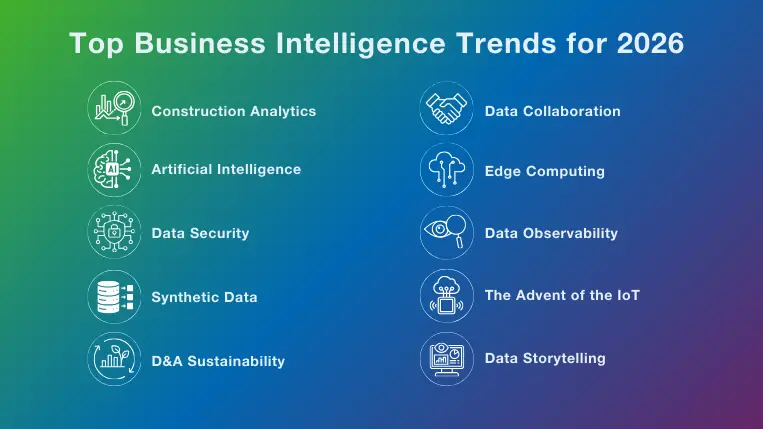
In this article, we’ve summed up what the near future of business intelligence looks like for us. Here are the top 10 analytics and business intelligence trends we will talk about in 2026:
Being data-driven is no longer an ideal; it is an expectation in the modern business world. 2026 will be an exciting year of looking past all the hype and moving towards extracting the maximum value from state-of-the-art online business intelligence software.
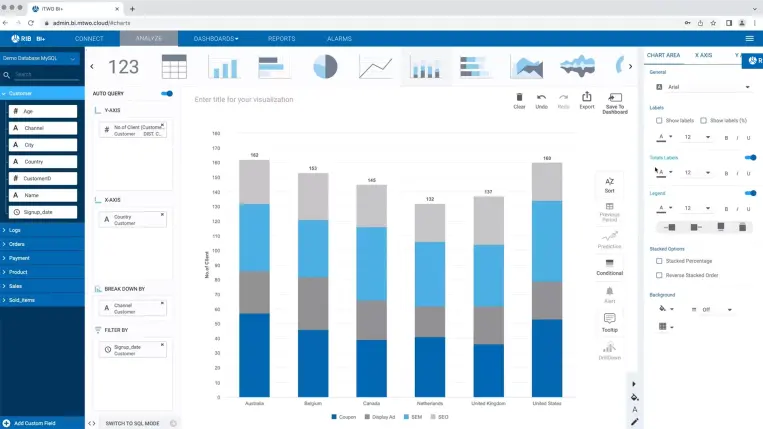
At RIB Software, we are committed to offering construction companies the best solutions to meet their needs. Our BI software, RIB BI+, is a state-of-the-art platform with innovative features to take your analytical journey to the next level. If you are ready to boost your performance and increase the ROI of your construction projects with data-driven insights, get a demo today!

Construction cost estimation is the foundation upon which projects in the construction industry are created. These careful computations dictate timeframes,...

One of the major challenges in construction project management is that productivity is not improving as rapidly as the industry...

RIB Software’s Jared Halbert, Senior Consultant, looks at why the right digital framework is essential for sustained, sustainable construction For...