16 October, 2026
28 mins read
28 mins read


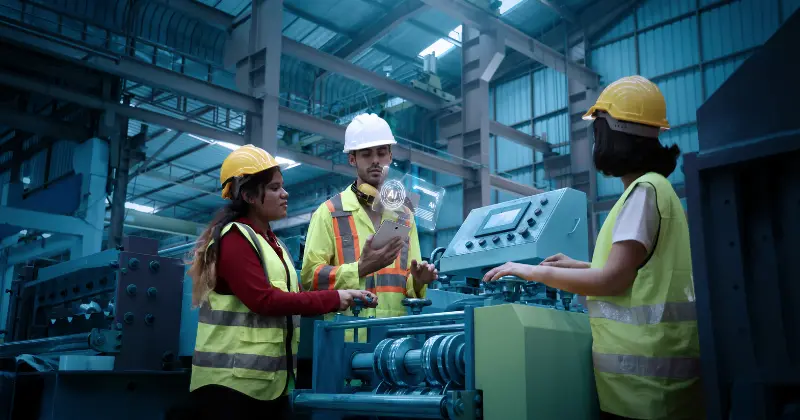
Artificial intelligence (AI) in construction is the use of smart software that learns from project data to automate tasks, support decisions, and predict problems.
The construction industry has been slow to adopt revolutionary technologies in the past, including Computer-Aided Design (CAD), cloud computing, and mobile apps. Hands-on work and complex projects make it difficult to implement the digital tools often used in more predictable environments such as manufacturing and transportation. However, Artificial Intelligence (AI) is poised to break this pattern of slow adoption, as improved productivity, safety, decision-making, and sustainability make the benefits too valuable to ignore.
AI is also becoming a frequent topic of discussion in the industry as the capabilities improve. The best way to separate facts from opinion, and learn how to use AI in construction effectively, is by talking to the experts. We looked to Wolfgang Müller, RIB Product Manager and AI Pioneer, who has over 40 years of experience in construction, for insight and guidance. We also caught up with Serial Entrepreneur and Best-Selling Author, Greg Wilkes, to find out how construction businesses can make the power of AI work for them.
Construction AI uses advanced computing to automate building tasks, analyse data, recognise patterns, and predict outcomes. Technologies such as machine learning, computer vision, and natural language processing allow teams to streamline their planning, progress monitoring, and resource allocation while improving productivity both on and off the jobsite.
The term “artificial intelligence” originated in 1956, but remained just an idea until recently, when high storage capacity, internet connectivity, and Graphics Processing Units (GPUs) capable of running thousands of calculations simultaneously converged to turn the concept into reality. Despite the physical nature of construction work, complex design requirements, large amounts of data collected during projects, and repetitive tasks make AI an ideal construction tool.
Experts and casual observers alike can see the enormous potential of AI technology in construction. Wolfgang Müller, RIB’s Product Manager, touted the benefits during an interview on our construction technology podcast, explaining how large volumes of sensor data are being converted into actionable insights that significantly improve decision-making, safety, and quality, while making project progress more apparent.
Other industry leaders, including Greg Wilkes, are leaning into Natural Language Processing (NLP) and automation capabilities to maximise the power of AI in construction. Wilkes emphasises the holistic impact of AI that extends well beyond the jobsite. Supporting functions ranging from sales and marketing to bookkeeping and procurement, are enhanced by AI, improving efficiency while eliminating or offloading tasks that add little value or job satisfaction.
When I think about where it's taking construction, I don't just think of construction as in the work we're doing on site.
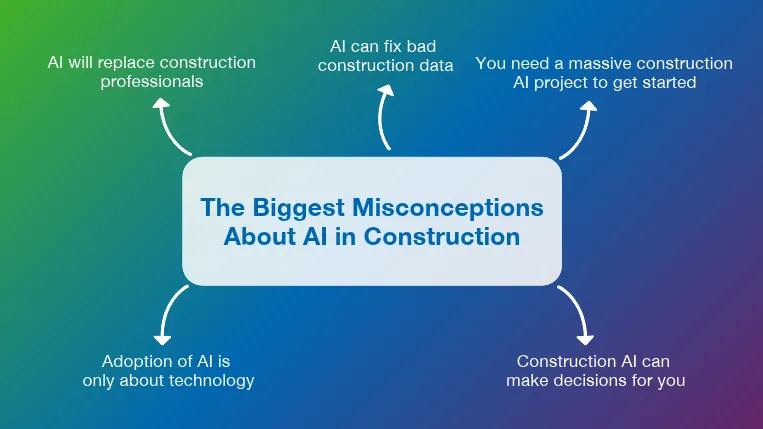
Maximising the potential of AI in construction management means breaking down some common myths and misconceptions that include:
The real-world dexterity, complex site recognition, and liability issues associated with construction work ensure human leadership and judgment will remain necessary into the foreseeable future, unlike strictly computer-based fields like software development or accounting. AI will also create many new opportunities, as workers are called upon to verify and clean data, improve system integration, and maintain autonomous equipment, among many other challenging roles.
As Greg Wilkes explains, “AI for many businesses is very, very worrying, but AI for construction, it is actually really exciting, because I think it's going to be a space where we're pretty safe for a long time.”
AI tools can recognize patterns and inconsistencies quickly, but they don’t know if the data itself is accurate, timely, relevant, or complete. Industry experts like Wolfgang Müller remind us why the term “garbage in, garbage out” is even more relevant in the age of artificial intelligence: AI can only provide benefits when data quality is maintained. For example, AI can detect a discrepancy between a building information modelling (BIM) platform and a quantity takeoff, but cannot tell you which of the two data sources is incorrect.
You do not need a major system overhaul to get started with AI in construction, since even a simple step forward - like using a readily available AI tool to review documents or databases - can make a big difference. This is why experts stress the importance of starting small when implementing artificial intelligence in construction management. Tangible results and rising comfort levels build trust that eventually makes broader use possible. Adoption can expand organically to incorporate resource management, jobsite automation, and purpose-built AI tools, as the positive momentum builds.
According to Wolfgang Müller, “AI helps people make better and faster decisions, work safer, and deliver better results, but AI is not powerful enough to act on its own.” Dire predictions of artificial intelligence in construction (and many other industries) taking over decision-making from humans cause alarm bells to sound, but these projections are not always realistic. Together with the technological limitations, safety, quality, and ethical concerns will continue to make human oversight and judgment essential.
The education of new and existing construction professionals must be a priority, so that AI integration can be ingrained in the industry culture. Much like the use of CAD, BIM, and cloud-based software platforms that are now standard, AI adoption will be the product of awareness, leadership, and gradual integration into existing workflows. The technology behind AI is undeniably impressive, but the human side of the equation is equally important.
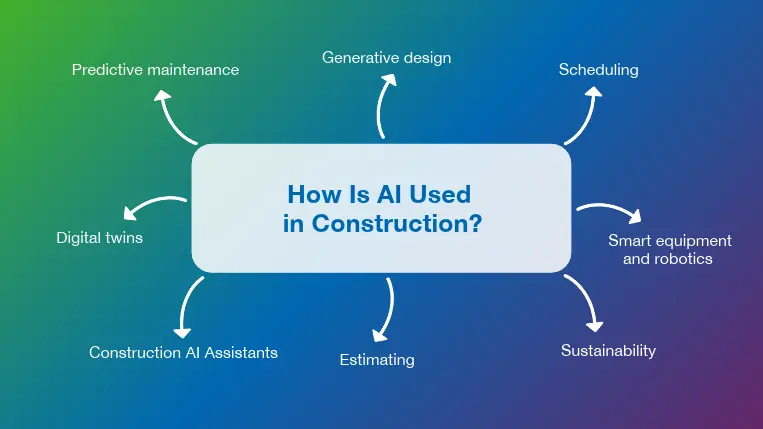
The momentum behind construction artificial intelligence continues to build, with AI capabilities now deployed during every project phase. The scope and reach of AI will expand in the years ahead, but the impact is already being felt in several key areas.
Tiny Internet of Things (IoT) sensors attached to heavy equipment and machinery track metrics such as temperature, vibration, and fuel efficiency to proactively determine when maintenance or repairs are needed. The same sensor technology is applied to the building itself, monitoring HVAC, plumbing, and other major systems. AI Machine Learning Models make it possible to predict imminent problems and prioritize maintenance tasks more efficiently.
With BIM platforms capturing the design, cost, schedule, and sustainability aspects of each project in the digital realm, AI makes it easier than ever to review and compare multiple design options before breaking ground. Artificial intelligence supercharges the generative design process by providing many viable alternatives based on cost, materials, life-cycle carbon emissions, and other constraints, and accurately predicting their long-term performance.
With historical data and building design information at their disposal, AI tools can deliver detailed Gantt chart timelines, complete with an optimised critical path, almost instantly. These baseline schedules can then be refined by human project managers and schedulers. Predictive capabilities allow timelines, priorities, and resource allocations to be updated continuously, based on weather events and other dynamic conditions. AI tools also streamline comparisons between planned progress and actual progress.
You're going to see planning and scheduling completely change.
The gap that separates traditional equipment like cranes, bulldozers, and backhoes from the advanced robots used for bricklaying, site inspection, and material handling is narrowing, with the help of the IoT and construction AI. In addition to predictive maintenance and automated asset management, AI capabilities empower equipment to perform complex or dangerous tasks without human operators on board, much like the robots used to pour concrete or weld skyscraper frames.
The interdependence between AI and sustainability is apparent, with construction sites becoming proving grounds for innovative new processes, materials, and design concepts that will shrink the global carbon footprint. Artificial intelligence in construction allows project teams to find the most energy-efficient alternatives and minimise their embodied carbon throughout the building process.
You can utilise AI to compare planned carbon footprint with real carbon footprint.
With an added boost from artificial intelligence, takeoff and estimation software helps to eliminate manual calculations and data transfer processes that can lead to errors, delays, and cost overruns. AI algorithms seamlessly factor in regional variation, historical performance, and other variables, while making it possible to produce accurate estimates and proposals with the click of a mouse.
AI Assistants are designed to augment the different construction roles and enable experienced professionals to focus on higher-value work, collaboration, and decision-making. It is trained to understand the workflows, project data and processes, and industry terminology that construction teams rely on every day. This allows construction teams to access information faster and make more informed decisions throughout the project lifecycle.
An AI assistant like RIB Omni is embedded directly into the project workflows, working within that context rather than as a separate application. By using natural language to help users find answers across connected data and documents, it replaces the need to manually search through construction drawings, documents, schedules, dashboards, specifications, or project records. It reduces repetitive, manual work with intelligent assistance and improves productivity without users leaving the workflow.
The virtual representations of buildings, infrastructure, or entire cities, known as digital twins, go well beyond 3D CAD models by using IoT sensors, cameras, and drones to mirror the real-time status of physical objects in the digital realm. AI is used to collect, organise, and analyse a wide range of data from the twin to predict issues before, during, and after construction. Construction digital twins are also useful for optimising building sequences and identifying potential safety hazards.
Digital twins are one of many AI use cases where data quality is imperative. Data quality refers to the accuracy, completeness, consistency, uniqueness, timeliness, and fitness for purpose that make data suitable for predicting outcomes or making decisions.
AI in construction requires high-quality data to prevent errors, safety issues, and costly delays. At the same time, fragmented sources, inconsistent formats, manual data entry processes, and rapidly changing site conditions make data quality an ongoing challenge.
After spending the past three years working on a large proof of concept for AI technology in construction, Wolfgang Müller now sees data quality as both a problem and an opportunity: “We need a lot of human resources to qualify the data,” he says. “So, there will be a lot of new jobs in the construction industry to qualify the information stored in these huge databases.” Each company must balance the human and energy resources required for AI and data management with the cost or time savings they can achieve.
Similarly, Greg Wilkes has pioneered Large Language Model (LLM) applications in construction, setting up agents to augment everything from sales and procurement to PhD-level consulting. These supporting functions also require clean data sources to maintain their credibility and compliance. “The more you use it and the more guardrails you put in place…the more you start to feel comfortable with it,” Wilkes explains. “And you know, it's not there 100% yet.”
Drawing on their firsthand experience with AI in construction management, industry experts provide valuable perspectives and practical recommendations that help organisations of any size adopt the technology successfully.
The experts we spoke to emphasised starting small with AI to overcome fears and objections; learning how to use prompts effectively can be a great first step. Prompts are the instructions, questions, or requests provided to an LLM to elicit a response. Examples might include:
The trial-and-error required to master the use of prompts allows construction professionals to explore the benefits of AI while building their comfort level.
AI tools help teams identify and prioritise design, cost, safety, supply chain, and schedule risk factors efficiently, which makes construction risk management and AI a perfect match. These capabilities are especially valuable on large and complex projects with dynamic risk profiles, since they make risks more transparent and enable engineers to justify their decision-making.
AI could give us hints where there are risks in our design phase, in our specification phase, in our construction phase, even in the operating phase.
AI relies on data from sensors, cameras, and drones throughout the jobsite to enhance schedule performance, quality, and accountability. This wealth of data also contributes to improved jobsite safety, as AI platforms monitoring the inputs predict hazardous situations and issue safety warnings and alerts. Wearable technology (smart headsets, glasses, badges, etc.) brings the safety benefits of AI and sensor technology to each individual worker.
Business experts like Greg Wilkes recognise the potential in AI to optimise sales and marketing strategies, customise ads, research client histories, and review project requirements efficiently. Client avatars and Augmented Reality (AR) glasses are among the AI-based tools providing a competitive advantage. “You're going to have a full transcription of what the client wants before you even get back in your truck or your van,” he says.
Wolfgang Müller stresses the importance of structuring and cleaning up data to make it suitable for AI. The next step in this data evolution is deciding what data can be shared with external partners, like subcontractors and suppliers, or even individual groups and departments within your own company. Müller suggests creating a dynamic table for data sharing rules: “There's a lot of coordination involved… AI means that you share your key knowledge.”
Among the sentiments shared by Müller and Wilkes is the usefulness of AI for evaluating and improving contracts and other legal documents. Rapidly evolving AI assistants can tell you what type of contract to use for each situation and review existing contracts for errors or omissions. AI agents are even being trained to perform cursory legal reviews, although this is one facet of the business where professional, licensed (and human) counsel remains essential.
Wilkes has pioneered the use of AI “procurement agents,” offloading the laborious process of obtaining and comparing quotes for building materials, then training the agents to call suppliers directly for live pricing. While this promising application may eventually become the norm, industry resistance persists: “So, the supplier that's picking it up, when they realise it's AI, they don’t like it, and they hang up,” according to Wilkes.
The ingrained AI resistance experienced by Wilkes must be overcome before the myriads of recorded images, conversations, checklists, and emails encountered on construction sites each day can be distilled into an ultimate source of truth. With improved transparency, data that already exists has the potential to resolve disputes quickly while fostering trust and cooperation. Ongoing training, education, and exposure to AI success stories will gradually break down these barriers.
The rapid pace of development makes the future state of artificial intelligence both exciting and unpredictable. For the construction industry, AI could be the key to reversing decades of declining productivity and the ever-present threat of labour shortages, while eliminating safety hazards that were once considered unavoidable.
The future of AI will be intertwined with global sustainability goals, as the efficiency and durability of new buildings are ensured through optimised designs, materials, and processes. Robotics and smart equipment will continue to play a significant role, with increasingly complex tasks performed autonomously and safely, leaving humans more time to create and innovate.
Construction planning, scheduling, and estimation functions are also being transformed, as integrated construction software gets a boost from purpose-built AI assistants. The next generation of AI solutions is already beginning to emerge.
Over 23,000 companies in 100+ countries trust RIB to future-proof their construction operations. Get a demo today and discover how RIB can unlock the power of AI for your business!