
Ebook
Discover the Hidden Power of Smarter Specs



Architects have always been known as the creative thinkers of the construction industry, using hand-sketched conceptual drawings, physical models, or advanced 3D software to turn new ideas into tangible designs. As green design principles, integrated construction software tools, and “smart” buildings and cities become the norm, the architect’s tool kit has expanded to include new innovations and practices. 2026 will see this trend continue, with advanced technology in architecture once again redefining what is possible.
In this blog post, we review the ways technology has impacted the field of architecture, and the important innovations that have changed the way buildings and structures are designed. We also look ahead to explore some exciting architectural technology trends for 2026 and beyond.
The complexity and originality of new buildings and structures have always been limited by the technology used in architecture. For centuries, this technology consisted of simple drawing boards, compasses, T-squares, and rulers as architects put their ideas on paper for construction engineers and other experts to evaluate their feasibility and visual appeal.
Computer-aided design (CAD) software was the first major technological breakthrough of the last century, allowing architects to create their 2D (and later 3D) building designs digitally. This made revisions, corrections, and analysis much easier, while providing the freedom to create more complex and original designs. As 3D design software improved in the 1980s and 1990s, these tools also supported virtual tours through conceptual buildings for architects, builders, and clients, while engineers used the self-contained models to evaluate structural elements, material choices, and safety factors.
Efficient digital tools made design elements like glass curtain walls, prefabricated building elements, and unorthodox interior and exterior spaces possible. The advent of Building Information Modeling (BIM), with detailed cloud-based models also incorporating design, cost, schedule, facility management, and sustainability information in a digital platform, marked the next phase of modern architecture technology integration as the 21st century began.
The new technologies in architecture are poised to take the industry far beyond the limits of current CAD and BIM software, with artificial intelligence (AI) expected to play a key role in expanding the creativity and potential of talented architects and designers. Advanced material options and building assembly concepts, ambitious sustainability goals, and “smart” cities and structures will call upon architects to leverage technology as they turn these exciting ideas into reality.
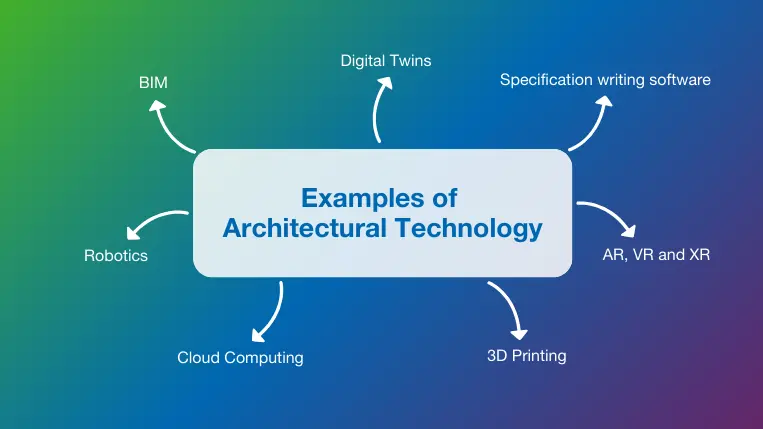
The importance of technology in architecture is not always visible to clients, occupants, and casual observers, but a powerful tool kit has emerged in recent years to give architects the freedom to create while improving aesthetics, safety, and sustainability.
While not new, data-rich BIM models have revolutionized the architecture industry by offering a shared environment where stakeholders, including engineers, project managers, and construction estimators, can review a design for errors, optimize material choices, and streamline project workflows. BIM has also become a leading architectural technology, since it allows complete designs to be created, reviewed and tested in the digital realm, while providing an ideal way to communicate ideas and concepts to clients and other stakeholders. Together, these capabilities highlight the many benefits of BIM, from improved collaboration and accuracy to reduced risk and greater project efficiency.
Digital twins in construction and architecture go beyond BIM or CAD models by using sensor data to continuously mirror the physical condition of the actual building. These advanced tools can be used to test building performance under various conditions during the design phase, then monitor elements like energy efficiency, structural integrity, and carbon emissions during building operation. The use of digital twins is now expanding from individual structures to entire complexes and cities.
Architects are known for producing detailed drawings and blueprints, but they are also responsible for creating a wide variety of specifications to define material, quality, and installation expectations, and complement the visual information found in drawings. Advanced specification writing software tools such as RIB SpecLink allow architects to manage all specifications from a central database, utilizing automated intelligence features to detect conflicts between specs, and pre-populate standard content automatically. These software tools also make it easier to collaborate with spec writers and other stakeholders virtually, maintain revision control, and accelerate the editing process.
Augmented reality (AR), virtual reality (VR), and extended reality (XR) make it possible to see new design elements or concepts projected over existing structures, or create entirely virtual full-sized, immersive building spaces for walkthroughs and reviews. Using advanced technology like smart glasses and AR/VR goggles, architects, designers, and clients can test different layouts, colors, and design concepts in a simulated environment to save time and minimize changes during construction.
Although it was once considered a rapid prototyping tool, 3D printing, where layers of material are deposited precisely to create an object directly from a computer model, has now advanced to create large objects, facades, or even entire structures using similar methods. The small-scale models that were once hand-built by architectural teams can now be 3D printed to visualize ideas more easily. Large scale 3D printing also gives designers a way to fabricate complex design elements that are not possible using traditional construction methods.
Cloud computing uses pooled resources for data storage, computing power, and application delivery to make real-time collaboration possible from any location in the world. This technology is also necessary for platforms like BIM and digital twins that continually gather information from multiple sources and locations. Cloud computing is essential for team collaboration on drawings, specifications, project planning, and virtual inspections requiring real-time data sharing.
Much like 3D printing and other new technology in architecture, robotics open new possibilities for architects by allowing intricate or complex geometric forms and shapes to be constructed accurately and precisely, and by speeding up repetitive tasks like bricklaying and painting that might be too time-consuming or expensive using conventional methods. Robots utilized on construction projects also improve sustainability by minimizing waste and the carbon emissions generated by human vehicles.
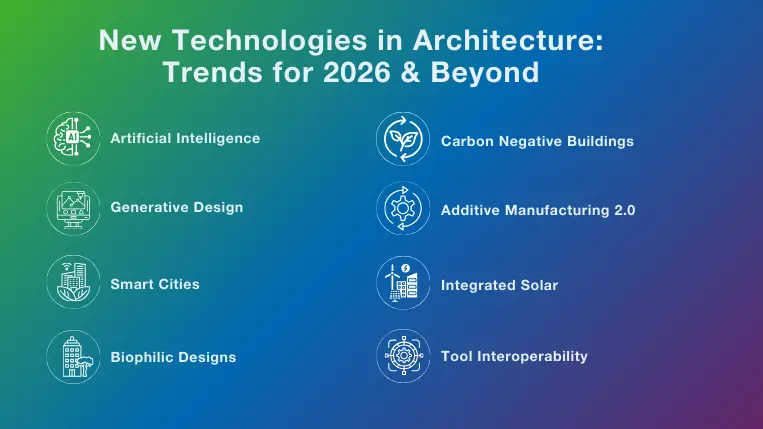
The tools and technologies we have described so far are just the beginning. The future of technology in architecture will see greater worldwide adoption of BIM management software, along with the development of advanced materials and methods that allow architects to design safer and more efficient buildings that are also visually appealing.
AI is already reshaping security, healthcare, manufacturing, and many other industries, and improving quality and cost performance in many key areas. 2026 could be the year when AI begins to have a more significant impact in the world of architecture. AI-powered software is already being used to automate tasks like site planning, specification writing, and code analysis to detect violations of building codes. Generative AI can create new visual concepts to supplement human innovation, and these capabilities are improving quickly.
Architects will continue to use their own creativity to develop unique building designs, but will rely on AI to refine concepts, identify potential feasibility issues, and make suggestions that can optimize building practices, reduce costs, or improve operational efficiency. AI is also the engine driving AR/VR solutions that make new designs come alive even before the first shovel of dirt is moved for a new project.
An important offshoot of AI known as generative design allows architects to review millions of potential configurations in the blink of an eye, then choose the best option based on goals like building size, sustainability, maximum occupancy, cost, and other relevant parameters. This saves valuable time that was once spent analyzing each option manually. This type of technology in architecture also makes it possible to test the feasibility of complex building forms and shapes that have never been attempted, and determine how they will impact energy consumption, structural integrity, and other important criteria.
Smart buildings utilize a combination of internet of things (IoT) sensors, AI, and wireless communication to improve the performance of systems like heating, lighting, and security, along with occupant comfort and efficiency. In the years ahead, smart buildings will continue to push this technology forward, with services like waste management and traffic flows interconnected to improve safety and quality of life for the entire community. Smart cities are impacting architecture by moving the focus from individual buildings and structures to entire planned communities. Architectural software tools must be capable of analyzing smart city performance before, during, and after construction.
The concept of biophilic design in architecture refers to the integration of natural elements like plants, animals, natural light, and waterways into building interiors and exteriors, to better connect people with nature while using plants to improve air quality and reduce the carbon footprint. Biophilic designs have also been proven to improve the physical and mental health of building occupants. While this concept has existed for decades, technology like IoT sensors, biometric feedback systems, and modular green walls will see the use of biophilic designs increase significantly in 2026 and beyond.
There are currently around 500 net zero commercial buildings and 2,000 net zero homes around the world, meaning they remove as much greenhouse gas emissions as they produce, or produce no emissions at all. Carbon-negative buildings stretch this goal further by removing more carbon than they emit. This is accomplished by using sustainable construction materials like wood, bamboo, and hempcrete that store carbon naturally, integrating biophilic design elements to convert CO2 into oxygen, and adding direct air capture systems to the building infrastructure to pull carbon out of the atmosphere. The rise of carbon estimating software enables architects and designers to calculate the environmental impact of building choices and materials, ensuring sustainability goals are met from the early stages of a project.
Processes like 3D printing are known as additive manufacturing, since they create objects by adding one layer of material onto the next using computer models and robotic dispensers. Almost anything an architect can imagine can be prototyped quickly for visual assessment or testing. Architects also use these capabilities to create new building features and facades that are difficult to build affordably any other way. Additive manufacturing 2.0 is the next step for this technology in architecture, with faster production speeds, lower costs, and more sustainable material options making this method practical for more applications and structures.
Designing buildings that consume less energy, or leverage renewable energy sources to reduce their carbon footprint, is an important element of green construction. Architects are now teaming up with scientists and solar energy experts to integrate available solar energy in new and creative ways. Building integrated photovoltaics (BIPV) allow basic construction materials like shingles, siding, and windows to act as solar panels that power the building without compromising the interior or exterior appearance.
The popularity of sustainable construction and green building certifications like LEED and BREEAM are leading more architects to use technologies like BIPV. The high demand is helping to reduce the cost of solar components, which often prevented their use in the past. Building solar, wind, geothermal, or other renewable energy sources directly into the infrastructure is a reliable way for architects to reduce carbon emissions over the entire building lifespan.
Another emerging trend is seeing all the technology used in architecture come together more seamlessly through tool integration and interoperability. For example, BIM takeoff software allows architects and other project team members to instantly assess the cost and embodied carbon impact of each design change, then roll this information into the estimate. Smooth data flows between tools and platforms is also needed to create accurate digital twins or automate the creation of construction specifications.
The new age of technology in architecture will see creativity and productivity enhanced simultaneously, as architects embrace tools and technologies like BIM, digital twins, AR/VR, and 3D printing that quickly turn ideas into reality, while optimizing construction cost performance and sustainability. Cloud-based specification writing software tools with built-in automation and embedded intelligence also support this transformation.
RIB SpecLink improves productivity and collaboration using customizable templates, live links to over 3,000 reference standards, and a database of 900+ drop-in content sections. Unmatched client resources, training, and support are always available to ensure users leverage the key benefits and features of these tools.
Get a free trial today and discover how RIB SpecLink can elevate your architectural specifications to the next plateau!

Construction cost estimation is the foundation upon which projects in the construction industry are created. These careful computations dictate timeframes,...
One of the major challenges in construction project management is that productivity is not improving as rapidly as the industry...

RIB Software’s Jared Halbert, Senior Consultant, looks at why the right digital framework is essential for sustained, sustainable construction For...