
Ebook
How Artificial Intelligence Redefines Construction



Sequencing is an important concept in almost every walk of life, with most written instructions, recipes, software programs, and problem-solving activities relying on activities being completed in the proper sequence. Ordered and organized activities are essential in the construction industry, where complex building tasks can be simplified through the creation of a logical chain of events that guides team members through the building process.
In this blog post, we explore the concept of construction sequencing to better understand how, when, and why it is utilized, and how it differs from closely related planning and scheduling activities. We also review some of the frequently asked questions on this topic and provide informative and answers that help you utilize sequencing for your own projects.
A construction sequence is the logical order of on-site activities and temporary works required to complete a project safely and efficiently. Sequencing spans the entire construction phase, from site setup to handover, but is distinct from a dated project schedule.
The sequencing process includes the creation of a detailed road map or plan that describes the correct chronological order for all construction steps. Logically, this begins with site preparation, grading, and foundation work, followed by a long string of operations that ultimately lead to a completed building or structure. Construction sequencing also helps to manage the flow of people, equipment, and materials, and improves productivity.
The construction manager, general contractor, or scheduler is typically assigned primary responsibility for sequencing tasks, but collaboration with architects, subcontractors, engineers, and other experts is needed to ensure the sequence is accurate and no steps have been left out. These activities should be completed during the preconstruction phase, since they provide a valuable input for the scheduling, planning, and resource allocation activities that follow.
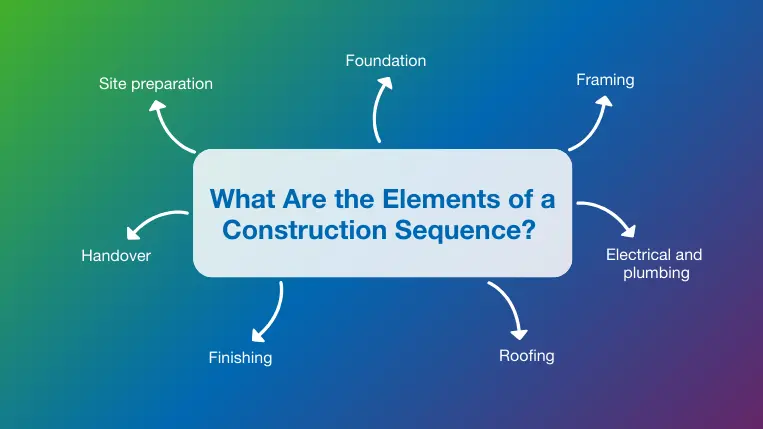
The elements of a typical construction sequence plan mirror the activities found in the construction phase of the project, with clear definitions of the required activities included, along with their order of completion. When tasks within the same phase or sub-category can be completed out of sequence or in parallel, this should also be stated. Although the specific work elements may vary, most comprehensive sequencing processes include the following chronological work categories:
When the clearing and preparation of a site begins, this marks the official start of construction activities, with workers and machines moving earth and materials for the first time. These activities can vary in their complexity, with some locations calling for careful preservation of trees and other natural elements. Site excavation is not part of the clearing process, but it follows immediately afterward when earth, rock, and soil are removed from specific locations to get ready for the next steps.
Almost all buildings and other load bearing structures include a foundation, and most foundations are still installed using traditional concrete, formworks, and steel reinforcements. The construction sequencing within this critical process begins with form building, mixing, rebar placement, and the pouring of footings, then moves on to additional concrete pouring, troweling, and curing steps. The size, scope, and cost of the foundation make it essential to ensure proper sequencing is always observed.
The installation of wood and steel beams to form the basic shape of the structure is known as framing. The critical processes in this category ensure the finished building will be safe, durable, and energy efficient, which leaves little room for on-site adjustments or undocumented modifications.
With some exceptions, framing operations must also be completed according to a predefined sequence that begins with still plate placement, door framing, and joist installation, followed by wall installation, sheathing, and bracing.
Once the frame is established, specialty contractors can get to work on the plumbing and electrical elements that bring the building to life. The work of subcontractors often overlaps and intersects as the structure begins to take shape, so the impact of the construction sequence on safety, efficiency, and accessibility must be considered well in advance. Work completed during this phase of the project remains visible until much later, when the drywall, insulation, and trim are finally put into place.
The intricate roofing process has a specific sequence of its own, designed to accelerate installation, prevent mistakes and rework, and enhance the safety of workers on rooftops and other dangerous locations.
Roofing involves important preliminary steps to install the sheathing, drip edge, tar paper and flashing that prevent moisture from making its way into the building after the roof is complete. The overlapping patterns associated with each roofing material require a specific sequence of their own to be followed closely.
The final steps in the sequence of a construction project are among the most important, since they ensure the appearance and function of the building meet design, quality, and client expectations. Exterior and interior finishing sequences are often completed simultaneously, with teams working to clean, waterproof, and paint walls, install cabinets and fixtures, and finalize landscaping elements. The finishing operations are the final activities in the sequence prior to the final inspection and walkthrough.
The handover is the final stage of a complete end-to-end construction sequence. As the name implies, the handover includes the official transfer of ownership from contractor to client, along with the transfer of as-built drawings, asset registers, material and system warranties, and other essential documents that must be listed in the documented sequence. Incomplete punch list items with the potential to delay handover should be prioritized so that their completion sequence is also optimized.
Creating a well-defined sequence of events to support construction planning, scheduling and operations is an extremely useful practice, but many people, both inside and outside of the industry, need additional information to help them understand this concept. We provide answers to many of the most frequently asked questions.
Creating a sequence for construction tasks is a valuable activity, since it helps to avoid delays, confusion, and rework by defining the proper order of operations and sharing it with all stakeholders. For example, if sheetrock is incorrectly installed prior to inspecting plumbing or wiring, costly and time-consuming rework might be the result.
A construction sequence also takes task dependencies into consideration, allowing activities that can be completed in parallel to move forward, and ensuring the right materials and resources are available to complete an operation once the gating items are completed. This attention to detail helps to eliminate any wasted time between activities or phases to increase productivity.
Sequencing is also important for quality and safety, since the correct order of inspection and test activities allows defects to be detected before any additional work has been completed that might conceal or compound quality issues. Demolition is a construction process that must follow a predefined sequence to guarantee safety, since all surrounding areas must be free of workers and hazardous materials before the operation can begin.
Construction scheduling and sequencing are similar and closely related concepts, but there are some important differences as well. Sequencing is concerned with the chain of events that must take place for a project to be successful, including dependencies that require one task to be completed before or after another. The primary goals of sequencing are to improve efficiency and minimize rework.
Scheduling also involves a review of task order and dependency, but combines this analysis with resource allocation, budgeting, and expected completion dates to provide more insight and context to go with the timelines. The scheduling process is greatly accelerated when the construction sequencing process has already been completed.
The high volume of materials and activities that go into a complex construction project can make it difficult to know where to start when creating an accurate sequence, but defining the project scope is the first important step. This includes removing tasks like material selection and warranty activities that are performed either before or after the construction phase.
The scope of the project can be assessed based on preliminary drawings and plans, along with conversations with designers, contractors, and clients, and a review of similar projects and sequences. With this preliminary information in hand, additional steps include:
Creating an accurate and efficient sequence in construction is a lot like assembling a complex puzzle. A change to one piece can impact many others, sometimes in less than obvious ways. The factors that can make sequencing a challenge include:
Construction project managers and other experts do their best to include all important tasks in the sequence, but it is easy to overlook activities and dependencies when final design, installation, and material choices are unknown. For example, the incorporation of prefabricated building components like walls, bathrooms, and kitchen units can alter the order of electrical, plumbing, roofing, and finishing activities.
A construction sequence is created based on the assumption that all necessary labor and materials will be available when they are needed. A shortage in either category can lead to delays that make it necessary to re-prioritize or reorder tasks to prevent resources from sitting idle. This might require a complete revision of the sequence with dependencies leading to major schedule changes.
The scope is the first and most important input when creating the sequence of a construction project, but it is also subject to frequent changes during and after the preconstruction phase. The sequence may require frequent updates to ensure it reflects the latest project status, and any change to the scope is likely to add, remove, or reorder elements of the sequence.
A sequence plan expands upon the information found in the chronological sequence by adding relevant information like project milestones, resources, identified risks, and additional, related information that helps to put the basic sequence in context. The plan might also include detailed descriptions of the individual tasks.
Stakeholders, including construction architects, contractors, and project managers with direct involvement in the completion of the project plan and schedule are usually responsible for creating the sequence plan as well. In many instances, this information is combined with the overall project plan to simplify document control and review processes.
Building information modeling (BIM) platforms that move design, cost, planning, and sustainability elements into the digital realm are valuable tools for efficient and accurate construction sequencing, since they allow teams to visualize the entire construction process, and proactively detect any conflicts, bottlenecks, or clashes within the overall sequence.
RIB 4.0 is an integrated enterprise platform used to digitize and enhance projects by connecting people, workflows, and data. RIB 4.0 supports 5D BIM integration, taking building information modeling to the next level by seamlessly integrating time and cost data into the overall model. This unique perspective allows the expense and timeline impact of each potential building sequence or design option to be modeled and evaluated accurately, to determine the optimal solution. RIB 4.0 also includes a built-in CO2 calculator to estimate your project’s carbon footprint and ensure you are making the most sustainable decisions in terms of materials, building processes, waste management, and more.
The construction sequence is something every architect, contractor, designer, and foreman should consider, since it is the invisible chain of events that ultimately leads to a successful project outcome. Each phase and building element carries its own unique sequence, and putting these puzzle pieces together successfully is a challenge that makes careers in construction worthwhile. Advanced software tools are simplifying this important task.
As part of the comprehensive suite of RIB Software solutions, RIB 4.0 includes modular solutions for estimating, business intelligence, bidding, scheduling, and more in one versatile package. BIM integration provides greater insight when transferring material, labor, equipment, and sustainability needs from the virtual world to the real world. RIB 4.0 also includes an advanced workflow engine to automate standard processes like invoice approval and document delivery.
To learn more about the many ways RIB 4.0 can accelerate and enhance construction sequencing for your projects, get your free demo today and begin to weave a digital thread through your operation!

Construction cost estimation is the foundation upon which projects in the construction industry are created. These careful computations dictate timeframes,...

One of the major challenges in construction project management is that productivity is not improving as rapidly as the industry...

RIB Software’s Jared Halbert, Senior Consultant, looks at why the right digital framework is essential for sustained, sustainable construction For...