Ebook
How Artificial Intelligence Redefines Construction


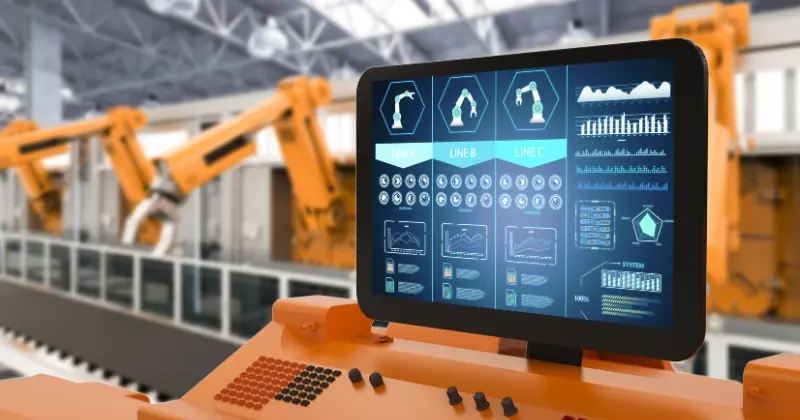
Automation has been an important part of the manufacturing industry for over a century, with machines, computers, and advanced software making tasks easier, safer, and more repeatable.
The diverse manual activities associated with building projects have made the implementation of automation in construction more gradual and selective, but advanced tools and technologies are poised to redefine the industry and open new possibilities for designers, construction project managers, and contractors.
In this blog post, we explore the definition and history of automated construction, and describe the technology and software that is leading the industry into the digital era. We also review some important trends that reveal how the role of automation is likely to expand in the decades ahead.
Construction automation combines advanced tools, equipment, processes, and software to replace manual, dangerous, and highly repetitive tasks. Automation also applies to project management and reporting activities such as spec writing, estimation, and resource tracking.
While some would say the dawn of automation in building construction is just now arriving, the first practical applications date back over 100 years, when motorized tractors, excavators, cranes, and bulldozers helped to replace many of the back-breaking manual tasks that had been part of the building process for centuries. Semi-automated drills, hammers, and saws also helped to speed up processes while improving safety for workers.
The 1950s and 1960s saw the industry take another step forward, as the industrial robots developed for automobile manufacturing slowly found their way onto construction sites. Robots proved to be ideal for many difficult, dangerous, or strenuous tasks such as welding, rebar placement, concrete pouring, and bricklaying. The role of the robot has continually expanded to include off-site prefabrication, 3D printing, and autonomous inspections.
Building Information Modeling (BIM), which moves critical design, planning, testing, and analysis tasks into the digital realm, became one of the first examples of software-driven automation when it first arrived on the scene in the 1970s. Cloud-computing, mobile applications, digital twins, and integrated construction software tools are now being synchronized with robotics, IoT sensors, drones, and other innovations as new possibilities and applications for automation emerge.
The adoption of automated tools and practices has accelerated as contractors, architects, specialists, and clients discover their important benefits, which include:
The repetitive tasks taken over by robots and other machines are often performed faster and more consistently, minimizing errors to prevent costly and time-consuming rework. These systems can also be programmed to operate continuously, with intelligent self-inspection capabilities reducing the need for direct human supervision. Rather than displacing workers, these efficiency gains allow experienced construction teams to focus on more complex operations and problem-solving.
Safety concerns in construction are based on exposure to hazardous substances, high surfaces, heavy loads, and other conditions that can be unavoidable during the building process. Autonomous machinery and robots can be used to complete many of these challenging tasks to keep workers safe. At the same time, worker monitoring systems and wearable technology help to automate important safety warnings and alerts.
While there is no substitute for human innovation and creativity, automated tools and systems improve quality by performing tasks more consistently and detecting quality issues in real-time. This precision applies to manual processes like painting, plastering, and cleaning, as well as intricate welding, framing, installation, and finishing tasks. This improved quality also makes project schedules more predictable while improving client satisfaction levels.
Automation contributes to sustainable construction objectives by reducing waste, improving energy efficiency, and reducing emissions. Artificial intelligence (AI) takes these benefits to a higher level by automatically adjusting workflows to minimize material and energy consumption, or changing construction sequencing to prevent project delays. Automated equipment powered by renewable energy sources helps to minimize the carbon footprint of the entire construction industry.
The global construction industry continues to struggle with labor shortages, as older workers retire, and fewer younger workers seek out construction careers. Addressing this chronic issue is another one of the advantages of construction automation, since robots, drones, autonomous machinery, and other innovations reduce demand for labor while improving overall productivity and making construction jobs more attractive to a broader range of workers.
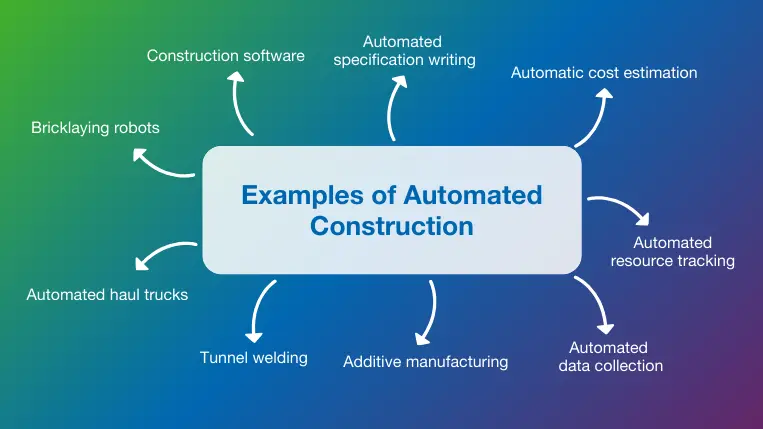
The list of examples continues to grow as the linkages between systems, tools, sensors, and software improve, and advanced construction technology enables more processes to be automated. Many examples of automation in construction also accelerate planning, resource management, and other essential project support functions.
Cloud-based construction software tools provide a centralized platform to streamline the collection and analysis of information, eliminate paperwork and manual data entry processes, and integrate with tools like AI and robotics to improve workflows, planning, and efficiency. Construction software also makes it possible to automate processes like ordering, scheduling, and resource management to build efficiency in the office that transfers directly to the jobsite.
Mobile apps, BIM, and other software innovations help to bring all elements of automation together to ensure the benefits outweigh the time and resources spent managing each system. Automation has become an essential feature for many of the industry’s leading purpose-built software platforms.
The high volume of specifications required for complex construction projects can make specification writing a tedious and time-consuming activity. At the same time, standardized content, specification interdependencies, and related industry codes and standards make automated spec writing a logical alternative. RIB SpecLink utilizes automated workflows, smart linking technology, and CSI-standard content to accelerate the writing process while improving version control, enhancing team collaboration, and minimizing errors.
Construction estimating is another common process that once required the painstaking transfer of information from paper blueprints to tables or spreadsheets. BIM models and advanced cost estimation software have automated this process by making on-screen quantity takeoffs from 2D or 3D design formats possible. RIB CostX is a premier software tool for automated cost estimation that includes live links to drawing and data repositories, embodied carbon calculations, and intelligent revision tracking to support multiple estimate configurations.
The construction resource management process is a collection of smaller tasks, including monitoring, scheduling, and data entry, to ensure the right materials, equipment, and labor are available whenneeded. Construction software brings a higher level of automation to resource management by analyzing data to optimize assignments, and sending notifications and updates to contractors and other stakeholders.
RIB BuildSmart construction cost management software streamlines resource tracking processes by providing global, real-time access to information with the analytical capabilities needed to optimize decision making. Advanced tracking features ensure up-to-date information on asset status and financial performance is available from any location. BuildSmart also simplifies subcontractor, equipment, and inventory management processes by automating data analysis and reporting functions.
Large and complex building projects, along with additional data sources like IoT sensors, mobile apps, and integrated construction software solutions, will soon make it impossible to collect and manage data without leveraging automation.
RIB 4.0 construction management software has been optimized to address this growing need, connecting people, workflows, and data seamlessly to improve collaboration and data transparency. RIB 4.0 also supports BIM integration and includes a business intelligence (BI) tool to deliver flexible analysis capabilities, smart predictions, and real-time alerts.
As the name implies, additive manufacturing processes are used to build objects of various shapes, sizes, and types by depositing thin layers of precisely placed material until the object is fully formed. Specialized software and automation are used to control the layering process continuously, based on the 3D design pattern.
The 3D printing used for prototyping and light manufacturing was the original application for additive manufacturing, but building facades, walls, and even entire structures can now be completed using this flexible process. Additive manufacturing reduces material and labor costs and makes it possible to construct complex shapes easily. As more builders and designers utilize this method, the global 3D printing construction market size is expected to grow by 111.3% between 2025 and 2030.
Long, wide, and repetitive tunnels around the world combine advanced civil engineering practices with autonomous construction processes. Tunnel welding is a prime example, with robotic equipment used to continuously weld the tunnel lining, produce rebar cages, and assemble other steel components within the structure. This technology can operate around the clock, improving schedule performance while reducing the risk of injury to workers in a confined and hazardous environment.
Driverless vehicles are becoming a familiar sight on roads and highways around the world. Automated haul trucks bring this technology to construction sites to simplify repetitive rock, soil, and waste hauling processes that once consumed long hours for human drivers. These large trucks use technologies like GPS, light detection and ranging (LiDAR) sensing, and pre-defined boundary systems to avoid obstacles and complete the loading and unloading processes safely.
Bricklaying is among the oldest construction tasks, but it is also a repetitive and labor-intensive process. At the same time, bricks and mortar must be joined precisely to prevent errors requiring major rework. Bricklaying robots can place bricks and apply mortar accurately, with some models also capable of cutting bricks for corners or complex designs. Semi-automated models assist humans performing this operation, while fully automated robots can complete large projects independently.
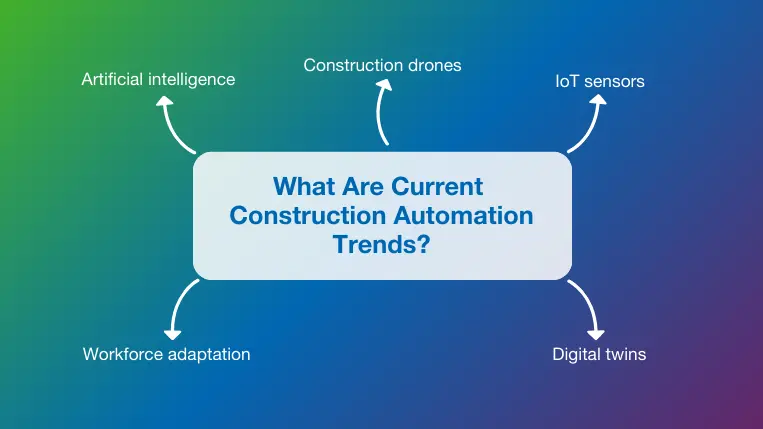
The use of software, robotics, and other practices originally developed for manufacturing continues to expand for new construction projects around the world, as the undeniable benefits of automation in construction become apparent. The direction of the industry has already changed in many exciting ways, but more recent trends in automation will see building efficiency and safety practices take another step forward while preserving employment opportunities for millions of construction professionals.
AI is making autonomous processing and decision-making possible in nearly every industry, and construction is no exception. AI and machine learning (ML) algorithms empower robots, drones, and other tools to make intelligent decisions on quality, workflow sequencing, and safety without human intervention, continually multiplying the applications for automated processing on construction sites.
Intelligent drones equipped with cameras, sensors, and recording devices have a wide variety of applications in industries ranging from public safety and research to media and entertainment. Drones are also becoming one of the keys to enhanced construction automation, with processes like surveying, mapping, progress reporting, and safety inspections being transferred from human operators to autonomous drones to save time and improve access.
The use of tiny “internet of things” (IoT) sensors in and around building sites, material storage areas, and personal protective equipment (PPE) is a trend that is quickly gaining momentum, with the rise of AI and 5G wireless making this technology more practical and affordable. IoT sensors are among the keys to advanced automation, since they provide the data needed to optimize safety, efficiency, and security, using construction software and AI to replace time-consuming walkthroughs and discussions.
Construction digital twins mirror the precise configuration, operation, and condition of a building or structure in the digital realm. Rather than simply modeling the physical design, the digital twin incorporates data from IoT sensors to create a precise, real-time representation that is maintained from the design phase through full operation. Digital twins enhance project visibility and collaboration while supporting automated safety alerts, workflow optimization, asset management, and predictive maintenance processes.
Automation helps to bridge long-standing workforce gaps in construction, but it also creates new training requirements for the existing construction workforce, and new opportunities for construction technology experts. Specialized knowledge and skills are needed to manage advanced robotics, drones, and software tools safely, and ensure the benefits of automation are being realized.
The slow adoption of technology that is typical in the construction industry has led to a methodical incorporation of automation over the past two decades. Construction software tools for data collection, resource tracking, spec writing, estimation, and other essential processes have now arrived to support the physical equipment and tools needed to bring next level automation to construction sites. With AI and ML providing an added boost, there is no doubt that the future of construction will be automated.
RIB Software is designed to automate essential construction support functions while providing the centralized data hub needed to manage the tools and equipment of the future. Over 23,000 companies in 100+ countries trust RIB to weave a digital thread through their construction operations. Book a demo today and discover how RIB can unlock the power of automation for your business!
One of the major challenges in construction project management is that productivity is not improving as rapidly as the industry...

RIB Software’s Jared Halbert, Senior Consultant, looks at why the right digital framework is essential for sustained, sustainable construction For...

What separates a successful construction project from a failed or break-even build? One of the most critical aspects to consider...