Ebook
What's Holding Your Company Back from a Successful Digital Shift?


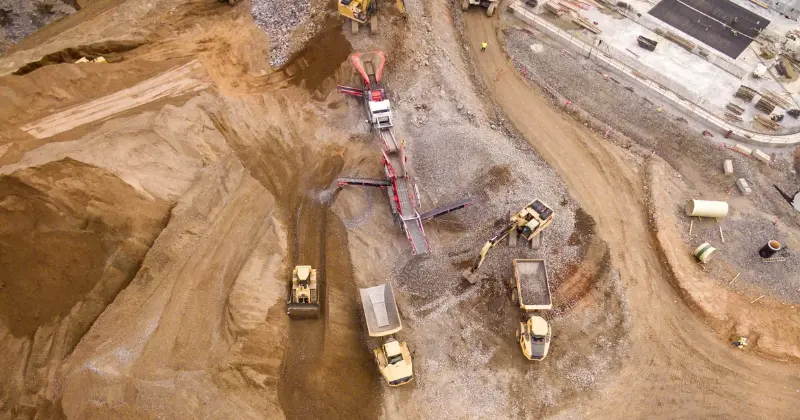
The US construction industry is one of the largest and most dynamic in the world, playing a critical role in shaping the nation’s infrastructure, economy, and skyline. From large-scale commercial developments to residential housing and public works, American construction companies are at the forefront of innovation, sustainability, and project delivery.
This blog post reviews a list of construction companies in USA’s high-performing sector, the trends shaping their operations, and the challenges they face in an evolving market.
The construction industry has been a key contributor to the United States economy for centuries, with a market value of over USD $2.2 trillion and continuous growth year after year. This expansion has been seen in residential and commercial construction, as well as major infrastructure construction boosted by federal investment. Despite the influx of government spending to support the growth of construction companies in the USA, private investment has also increased significantly in recent years.
Continuing this positive trajectory will mean resolving ongoing labor shortages, with the industry needing to attract an estimated 34,900 new workers just to fill current openings. Rising material costs, high interest rates, and regulatory challenges can also make it difficult to meet the high demand cost-effectively. Automation and workforce development strategies will help to reduce the skills gap in the years ahead, with higher wages and safer environments making construction work an increasingly popular career choice.
The adoption of construction software, IoT devices, and building information modeling (BIM) are quickly gaining momentum in North America with these tools becoming essential to the growing percentage of US firms shifting focus to green construction practices.
The boom in artificial intelligence (AI) is also impacting the biggest construction companies in the US in many ways, with hyperscale data center projects employing thousands of workers, and predictive analytics, digital twins in construction, and other AI-driven software innovations improving job site quality, decision-making, and efficiency. At the same time, there has been a rapid influx of small firms and independent operators substantially increasing the overall number present in the US.
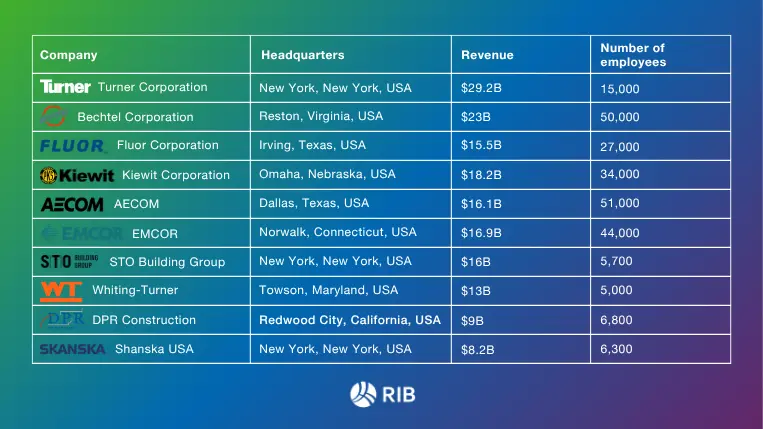
With almost 3.8 million construction companies in the USA employing more than 10 million people, it’s not so easy to make a top ten selection. Some of the largest industry players in the country are still fairly new to the scene, while others have a century or more of experience completing ambitious building and infrastructure projects. While many factors can be used to rank the top construction companies in the USA, we’ve chosen to prioritize our list according to current annual revenue.
Topping our list of construction companies in the USA is Turner Construction Company. This diverse international building organization has been a major contributor to large and complex projects in the US and around the world since 1902. With 15,000 talented employees on hand helping the company generate USD $29.2 billion in revenue per year with a project backlog of $44.3 billion, Turner Construction has earned their industry reputation by developing steel-reinforced concrete for general building purposes. This technology was the key to many of their well-known, which includes Madison Square Garden Arena in New York City.
Current healthcare, transportation, government, and commercial projects carry on this tradition, with the San Francisco Airport Terminal 3 modernization and the Bayfront Health Medical Pavilion in St. Petersburg, Florida, recognized for their originality and innovation. Turner was recently honored by Forbes as a top employer for women and new graduates, and also named one of America’s Best Large Employers in 2026.
Bechtel Corporation is another business consistently ranking among the biggest construction companies in the US. This engineering, construction, and project management company was founded in San Francisco, California, in 1898. Its founder, Warren A. Bechtel, began his journey in the railroad industry and quickly expanded into highway, bridge, and building projects. The Bechtel Corporation has built a global reputation for first-of-their-kind projects, ranging from renewable energy infrastructure and manufacturing to mining and environmental cleanup. With over 50,000 employees in almost 40 countries, Bechtel’s annual revenue now exceeds USD $23 billion.
Recent and ongoing projects that demonstrate the strength of Bechtel engineering and project management expertise include the Clinch River nuclear reactor in Tennessee and the Edmonton Light Rail Transit in Alberta, Canada. Bechtel is also participating in NASA’s Artemis moon exploration program by developing new construction and power technologies for the lunar surface. The company lists safety, quality, and sustainability among their core values, with advanced materials and technologies used whenever possible to reduce environmental impact.
Founded in 1912 by a family of Swiss immigrants, Fluor Corporation has developed expertise in energy infrastructure for over a century, gradually expanding its reach to include mining, metals, manufacturing, and life sciences. Over 27,000 employees in more than 60 locations have contributed to successful projects, such as the JFK Airport International Arrival Terminal in New York City, and the carbon-free Innovation Experience facility for Southern California Gas Company (SoCal Gas).
Fluor recently reported annual revenue of USD $15.5 billion, with a backlog of new project commitments totaling over USD $25 billion. Industry leadership is also seen in their commitment to innovative and sustainable solutions - their goals of achieving net zero Scope 1 and Scope 2 emissions were reached on schedule in 2023. The company actively tracks greenhouse gas emissions and embodied carbon on all their projects to ensure that they’re able to achieve their future sustainable goals.
The deep roots of Kiewit Corporation extend beyond many other top construction companies in the USA, following the launch of a small masonry contracting business back in 1884 by brothers Peter and Andrew Kiewit. Complex freeway, energy, and military infrastructure projects filled the company’s portfolio over the ensuing decades, with the company now earning an impressive USD $18.2 billion in annual revenue through their engineering and construction services.
Over 34,500 Kiewit employees enjoy cutting-edge training and meaningful responsibilities that make Kiewit such a sought-after workplace for construction professionals. Recent projects that demonstrate the talent and creativity of the team include the Dallas-Fort Worth Freeway Connector and the 80-megawatt Zier Solar and Storage facility in Texas. Sustainability and continuous improvement are core values for Kiewit projects and employees.
AECOM Construction Management comprises twin divisions, namely, AECOM Tishman and AECOM Hunt, each with complementary expertise in arena building, residential developments, and large commercial projects, such as the 82-story Park Place Tower in New York City and multiple venues earmarked for the 2028 Los Angeles Olympic Games. These landmark accomplishments contribute to their annual revenue of USD $16.1 billion. AECOM is currently ranked first nationally in the Sports category, and second in the Airports category, based on Engineering News Record (ENR) ratings.
There are approximately 51,000 workers currently in AECOM’s employ, making it one of the largest construction companies in the US. Its business structure is the result of numerous mergers and acquisitions over the past 30 years - this includes engineering, design, and planning firms that strengthen the company portfolio. AECOM also supports the ambition of the Global Biodiversity Framework to reverse nature loss by 2030.
Headquartered on the US East Coast, EMCOR Group, Inc. is a provider of critical infrastructure and renewable energy systems with USD $16.9 billion in annual revenue and significant year over year growth. EMCOR’s core competency lies in building and enhancing facilities of all types through advanced electrical, mechanical, heating, and security systems, spanning a wide range of industries.
Like other successful construction companies in USA, EMCOR was formed through a series of strategic acquisitions in specialties that have collectively carved out their unique industry niche. Rapid expansion in recent years has led to the employment of more than 44,000 workers in over 420 locations throughout the country. The company’s environmental policy establishes its commitment to sustainable practices and support for LEED and BREEAM building certifications.
The STO Building Group offers a wide range of services, including site selection, design constructability review, infrastructure upgrades, and new building construction. Founded in 1985, STO is a privately-owned business made up of 14 brands, with 50+ office locations around the world. A staff complement of over 5,700 people has helped STO grow their annual revenue to USD $16 billion in 2025. The company points to client devotion, collaboration, and honesty as important core values.
Landmark projects for STO have included the renovation of Saint Patrick’s Cathedral and a flagship Bank of America facility in New York City, the University of Pennsylvania Energy & Science Laboratory, and several large data center retrofits to help meet the growing demand for computing power. The company also supports numerous community-building and sustainability projects, including mentoring programs for women in construction, as well as a “Mass Timber Movement” aimed at reducing embodied carbon in new building projects.
Next on our list of construction companies in the USA is Whiting-Turner, a premier construction management and general contracting firm that was established in 1909. The company has gone from early reinforced concrete and infrastructure projects to diversifying into sectors such as education, healthcare, and entertainment. Current projects include the expansive John Palmour Manufacturing Center in North Carolina and the (net zero) LEED Platinum certified Under Armor Headquarters in Baltimore, Maryland.
Whiting-Turner is a private, employee-owned business with approximately USD $13 billion in annual revenue and over 5,000 employees spanning 60 US locations. The company is committed to diversity and inclusion, with opportunities extending from management to all employees, along with strategic vendor and contractor partnerships.
California-based DPR Construction cracks our list of top construction companies in the USA as a “self-performing” contractor focused on highly complex building projects - it was founded around 35 years ago. With USD $14.1 billion in annual revenue and 13,500 employees, DPR has built their reputation for quality and integrity through a series of sustainable medical, commercial, entertainment, and manufacturing facilities.
Recent projects in the USA include the stunning Block 185 Office Tower in Texas, the Sutter Davis Hospital expansion in California, and many of the largest computer data centers in North America. The self-performing model developed by DPR allows them to complete projects using their existing staff alone, rather than seeking out new contractors or sub-contractors for each opportunity. The company recently put their ambitious sustainability objectives into practice by initiating embodied carbon lifecycle analysis practices.
One of the largest and most financially sound construction companies in the country is Shanska USA, headquartered in New York City. The company was incorporated in 1971 as an offshoot of the global Shanska Group that was founded in 1887. The USA division of Shanska generates over one third of their overall revenue, USD $8.7 billion, and employs 6,500 of its 25,900 workers.
Shanska USA recently completed the redevelopment of the Portland International Airport and is nearing completion on the 3.7 kilometer Portal North Bridge in New Jersey. Despite their current focus on large-scale infrastructure projects, the group has also demonstrated their commitment to sustainability, with the goal of reaching net-zero carbon emissions by 2045.
Like many other nations with a large construction sector, the US industry is contending with high demand for new infrastructure, rising material prices, and stubborn labor shortages. The growth of AI and other emerging technologies has inflated the project pipelines for many major construction firms, while others experience slowdowns from economic headwinds.
Let’s address some of the most frequently asked questions in order to paint a more complete picture of what the US construction industry looks like today.
Based on revenue, Turner Construction Company is the largest, with over USD $29 billion in 2025 edging out the equally impressive $23 billion earned by Bechtel in the same year. Turner has assumed the top spot with less than one-third as many employees - their combined expertise in transportation, healthcare, and commercial construction has also helped them establish a sizable backlog.
Along with Bechtel and Turner, Kiewit, Flour, and AECOM consistently feature among the largest construction companies in the US, each with a long history influenced by increasingly complex projects, proactive construction software integration, and ambitious sustainability and carbon reduction goals.
Recent IBISWorld research estimates place the number at approximately 3.8 million, with significant growth seen each year. Many businesses included in this total are specialized contractors who are benefiting from the rise of AI and government investment in infrastructure. The vast majority are one-person firms, meaning they don’t need to hire or train workers. This distinction accounts for other estimates that place the total number of construction companies in the USA closer to one million. US states where residential construction has remained steady, including Texas, Arizona, and Florida, are seeing the most emerging businesses formed.
The USA isn’t immune to the material price increases, skilled labor shortages, and safety risks being experienced around the world. Additional challenges unique to US firms include sustainability regulations and permitting processes that vary by state, complex construction contracts for mega projects that span many years, and restrictions on imports that force contractors to purchase more expensive materials.
These challenges make it more difficult for small companies to scale and expand into other regions. However, firms are increasingly turning to construction management software to optimize contract management, regulatory, and procurement issues, helping them overcome many of their biggest hurdles.
Sustainability in the construction industry is a major focus area for all the most successful and largest construction companies in the US, including those among our top 10 list. In addition to the rise in sustainable building and renewable energy power plants, Fluor, Turner, and Shanska are throwing their weight behind the growing list of firms setting firm net-zero targets to dramatically reduce their carbon footprint.
Many factors contribute to this positive trend, including government incentives, customer demand, and a shift to green modular construction methods that can accelerate schedules and compensate for labor shortages.
In most cases, having a set of clear requirements with a realistic budget is a good starting point, but these decisions should never be based on the lowest bid. Interactive subcontractor management databases allow clients and general contractors to verify relevant experience and review licenses, references, and other credentials all in one place. Construction software solutions for bid management, takeoff and estimation, and procurement also make it easier to perform apples to apples company comparisons.
As the demand for smarter, faster, and more sustainable building solutions grows, construction companies in the USA are under increasing pressure to adapt and lead. Those that embrace digital transformation, prioritize skilled labor, and stay ahead of regulatory and economic shifts will be best positioned for long-term success, successfully navigating the industry’s opportunities and risks.
RIB Software is committed to delivering robust solutions that assist construction firms throughout their digital journey, providing enhanced collaboration, project planning, procurement, and optimizing estimation through to handover and operations.
If you want to see your firm’s performance skyrocket, leverage innovation and the support of a community of expert construction professionals. Request your free demo of the RIB toolkit now.

Ebook

Construction cost estimation is the foundation upon which projects in the construction industry are created. These careful computations dictate timeframes,...
One of the major challenges in construction project management is that productivity is not improving as rapidly as the industry...
RIB Software’s Jared Halbert, Senior Consultant, looks at why the right digital framework is essential for sustained, sustainable construction For...