Ebook
What Does Disconnected Construction Really Cost?


Building information modeling (BIM) ranks among the most useful and significant innovations in the history of the construction industry. In a cloud-based solution, it features multi-layered digital models designed to dramatically improve collaboration and efficiency, while reducing errors and waste throughout the project lifecycle. At the same time, implementing BIM doesn’t come without its challenges - and the challenges of BIM implementation can easily outweigh the benefits if they’re not addressed proactively.
This blog post reviews eight of the most significant BIM challenges facing construction professionals, and recommends tools, practices, and skills to help practitioners overcome them, including the key role that BIM management software plays in resolving these issues.
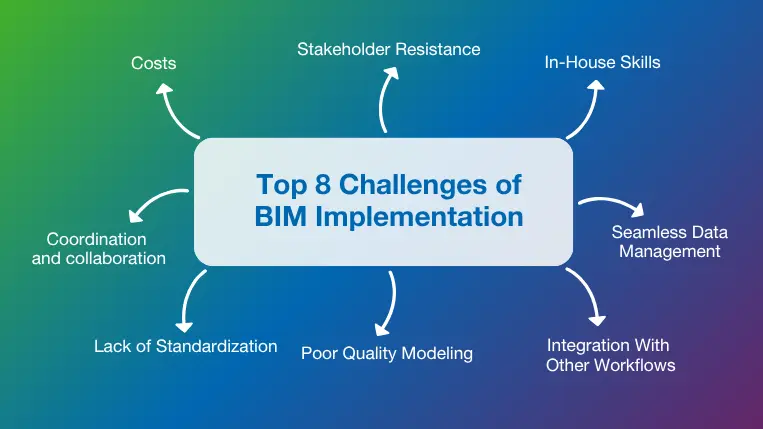
We have reviewed the top BIM challenges and roadblocks on the road to successful implementation to better understand the consequences and potential remedies. Once addressed, this complex tool can be leveraged appropriately to add tremendous value to projects.
The cost of implementing BIM can easily be offset by the reduced waste, manual data entry, and design clashes that can derail project timelines and construction budget management. However, for some construction firms, the upfront costs for software, hardware, training, and IT resources may add up to more than they’re willing to invest. BIM execution plans and other documents and procedures also take up time and resources. The return on investment can be hard to quantify since cost benefits tend to accrue gradually over time.
Like most technologies with a slow, steady increase in adoption, higher usage rates will eventually lead to lower initial costs. This process is being helped along by mandatory BIM adoption for public projects in many countries, and shifting perception of the BIM value proposition as more organizations share their positive results.
Resistance to change is a common theme in our industry as workers naturally prefer to continue with the tools they’re most comfortable with. The introduction of new technology as in the case of BIM processes represents a huge change from the familiar 2D drawings and manual workflows that have been the standard for decades.
Ironically, the first CAD technology in architecture over three decades ago followed a similar adoption path. Back then, the value, efficiency, and ease-of-use offered by CAD tools led to strong support from management teams, and resistance was overcome as more users learned about the features and benefits. It teaches us that educating clients about the benefits of BIM is key to driving adoption and successful implementation.
Overall, greater adoption requires a strong commitment to training. Unlike basic CAD tools, BIM also requires specialized knowledge of data management, model integration, clash detection, and other skills that are difficult to find. This elusive expertise is essential when dealing with the complexity of BIM-based projects.
Designating or hiring a qualified BIM manager to oversee implementation, then providing training for the entire team, can be expensive and time-consuming. To support organizations that lack the in-house skills needed to overcome the challenges of BIM implementation, external experts and BIM service providers can help to bridge these gaps in a cost-effective way.
BIM projects can generate a massive amount of data from many different sources. This must be organized, stored, and protected effectively to ensure that the model is performing as intended - and avoid confusion and inconsistencies. Data collection and tracking processes, along with data security and access management practices, must be in place to prevent project delays, errors, or collaboration issues.
A strategic data management plan (DMP) helps to overcome these BIM challenges by standardizing practices, establishing clear policies, and ensuring compliance with industry standards. A consistent approach will boost efficiency while ensuring data sources are reliable and consistent over the course of the project.
As amazing as BIM capabilities and benefits are, building information modeling cannot and does not operate separately from other business workflows. Legacy accounting, construction scheduling, project management, and construction estimating software tools must be integrated seamlessly to ensure data is shared correctly across all platforms. Software solutions designed to support BIM integration natively provide another viable option for teams taking a holistic approach.
Interoperability issues between unique software tools used by engineers, architects, and other stakeholders can present problems when file formats are incompatible - these issues must be addressed early in the project lifecycle, so that norms can be established and unexpected delays are avoided.
In the process of dealing with poor data management, training, and stakeholder resistance, the issues we’ve explored can also contribute to poor model quality. Incomplete or inaccurate information, incorrect material specifications, excessively large files, and outdated information are among the attributes of inferior models that lead to clashes, errors, or rework in the model or (worse yet) in the field, if the problems are not detected early.
Standardized templates, model reviews, and automated validation tools help address these model quality issues proactively. BIM model validation is used to systematically check model geometry, spatial accuracy, formatting, naming conventions, and completeness to improve quality and consistency.
The issue of standardization extends beyond managing data to individual workflows, component models, and high-level model integration. Standard naming conventions, along with classification systems like OmniClass, ensure the information in each model or file is easily understood by all stakeholders. Standardization improves interoperability by ensuring basic components like doors, beams, and windows are reusable within and between BIM projects.
Teams can improve standardization by drafting a comprehensive BIM Execution Plan that details project-specific goals, workflows, conventions, and construction quality control measures. Standardized templates with pre-set parameters also help to improve consistency among users.
Although BIM is meant to improve collaboration, it demands a high level of coordination and communication, which is something not all teams are used to. Instead, teams are typically siloed and lacking in coordination, which can cause delays in model completion, systemic errors, or unexpected clashes between building elements, threatening project success.
Cloud-based BIM platforms are designed for real-time collaboration in construction and information sharing from any location but failing to utilize these capabilities to align tasks and priorities can undermine some of the key benefits. Mobile software platforms that provide on-the-go access to the latest models, data, and reports help to bridge lingering coordination gaps.
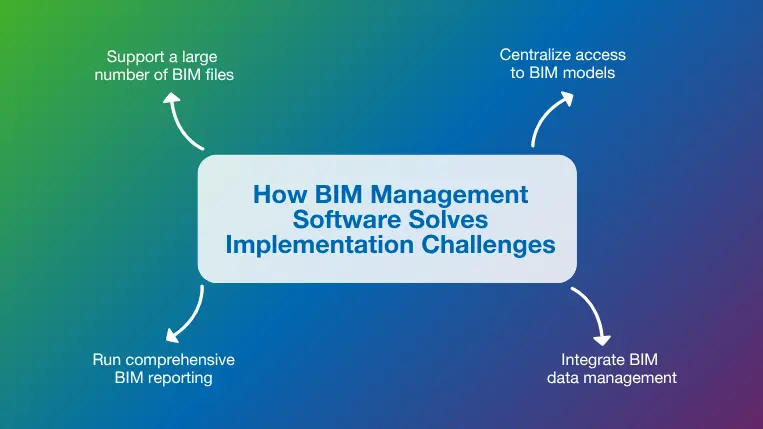
Many of the challenges of implementing BIM can be overcome through research, planning, and teamwork. There are also versatile software tools available to ease implementation while improving the chances of project success. For example, RIB’s BIM management software features tools that help users circumvent the pitfalls and maximize the benefits. This is purpose-built for BIM takeoff and estimation, data and project management, planning, file sharing, and digital handover, forming a complete solution with a range of game-changing capabilities.
Support for a wide range of BIM file types, including DWF RVT, IFC, and others is essential to streamline interoperability, ensure team alignment, and avoid modeling quality issues. Integrated BIM management links 3D models directly to project information.
Cloud-based document and project management tools allow BIM managers and other stakeholders to organize models, files, and documents, even from mobile devices in the field. Centralized access to BIM models improves team communication and collaboration, supporting efficient workflows.
Advanced data management capabilities link BIM models to project information to avoid fragmentation, improve productivity, and provide a single source of truth. Effective and systematic O&M data collection throughout the build supports an efficient handover process as projects reach conclusion.
Centralized data access, intuitive dashboards, and integrated supporting tools lead to timely and customizable reports related to project management in construction, cost control, and E&O. These reports improve transparency and decision-making by keeping the team up to date.
Many of the world’s most advanced and visually stunning buildings and structures have benefited from building information modeling. While the challenges of BIM implementation are less apparent at first, they require due diligence in the interest of preventing minor misconceptions and oversights from standing in the way of success. Thankfully, innovations are helping industry professionals to overcome some of the more stubborn barriers to adoption.
RIB Software offers various advanced solutions to support BIM workflows, turning BIM challenges into opportunities. Discover how to unlock the power of BIM for your business and book an RIB demo now.

Construction cost estimation is the foundation upon which projects in the construction industry are created. These careful computations dictate timeframes,...

One of the major challenges in construction project management is that productivity is not improving as rapidly as the industry...

RIB Software’s Jared Halbert, Senior Consultant, looks at why the right digital framework is essential for sustained, sustainable construction For...