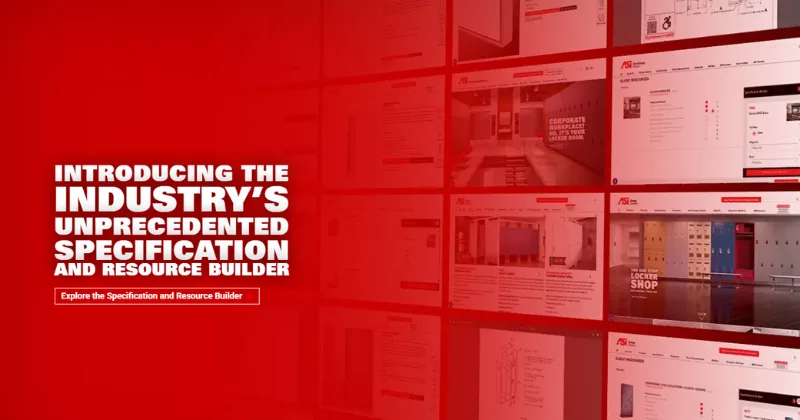
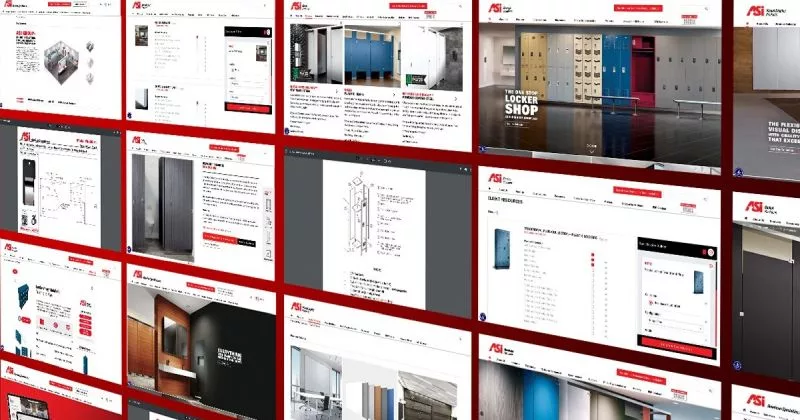
The purpose of this tool at a high level is to try and make our websites sticky, so anyone that visits our websites and sees something they like now has an opportunity to generate an output that will help them.
Mark Schiller, VP Sales and Marketing, ASI Group
The Customer
ASI Group is a global Building Product Manufacturer (BPM) with operating units and offices in the United States, Canada, Australia, Europe, the Middle East, Mexico, and China. The group has been around for 65 years, leading the world in the manufacture of commercial toilet partitions, washroom accessories, lockers, and visual display units for the construction industry. With sales in over 50 countries, ASI has expanded its ability to serve architects, building owners, and contractors worldwide.
The Mission
Product specifications are notoriously time-consuming, and as they are typically copied from project to project for decades and manually edited, they also become outdated. ASI wanted a way to simplify and improve the process to provide more accurate, clear and ultimately, faster specifications that would take hours of work out of the process for end users. They faced difficulties delivering relevant specs to architectural firms due to a large product portfolio and outdated methods, leading to the collaboration with RIB to develop a tool that enables architects to generate project-specific specifications easily and without registration.
The Solution
The search for a digital tool that wouldsimplify the workflow to build confidence in reliable, automatically updated specifications led them to RIB SpecLive. They developed the tool to sit on their website, producing accurate, preconfigured specifications that were always up to date and easily accessible to all end users. In the process, they modernized the specification process, creating a generator tool that delivers relevant product content where it’s needed – instantly accessible to architects, specifiers, and anyone needing ASI’s data.
The Result
Since the launch of the tool, over 200,000 specifications have been generated for ASI Group products. In conjunction with the generation of specifications, the specification share rate for ASI products has increased across all product lines with increased exposure, and the use of adjacent content that is important for architects, designers, and specifiers, has also increased. In partnership with RIB SpecLive, ASI has effectively refined the specification generation process, making it more efficient for users of the tool.
We wanted to develop a tool that would make it easy to generate a specification, leveraging the information that already existed and platforms where our content already resided.
Mark Schiller, VP Sales and Marketing
Generating Specifications with Ease, Accuracy, and Relevance
ASI Group's objective was to create a digital specification generator tool that simultaneously addressed the challenge of outdated and inefficient specification processes. They were looking at various approaches to get their products in front of the architectural community and into more projects, and one of the challenges was that, while they had a large product portfolio, it was difficult to match clients with up-to-date specs that were relevant to both ASI’s products and the architects involved. This identified the need for a more efficient tool that would allow them to generate specifications easily, accurately, and suitably relevant.
Working with existing content, with respect to time-conscious architects working on multiple projects at once, they:
Leveraged the content on their website where they showcase their varied catalog of products
Enabled architects to generate a relevant specification simply by clicking on their product of choice, without needing to register first
Generated well over 200,000 specs within just 18 months since product launch
Increased their spec share rate across different portfolio products in the marketplace, as well as increasing market share
It’s fundamental to make sure that the information that any tool you're using leverages content that is accurate and relevant and current.
Mark Schiller
Simplifying Digital Specification for Efficiency
Previously, ASI Group’s approach to managing product data for specifications was very outdated. They would follow a time-consuming process, using Word to generate three-part specs with architects. This wasn’t the most efficient process, with the most consistent outcomes, given what a precious commodity time is in the current marketplace.
They found the marketplace flooded with outdated content, not only from ASI but also from other BPMs. The process for generating specs was outdated. Nowhere in the market could they see a tool that would allow architects to update specs that didn’t rely on the old cut-and-paste approach. So, the concept of developing a solution to streamline specification generation for architects was the crux of the opportunity.
With SpecLive Assist, they could leverage their existing content, given that they were already in the proprietary specifications within RIB. The collaboration resulted in the specification configuration tool that helps users to select, tailor, and generate accurate product specs efficiently from ASI’s digital content.
How adoption worked and what was learned:
The SpecLive Assist tool replaced inconsistent, time-consuming Word document specifications with a streamlined, efficient process.
ASI’s organizational culture supports the way this tool empowers users to self-serve.
There was a high level of internal acceptance across their line managers, marketing, product development, and technical services, which facilitated easier communication with stakeholders.
The effectiveness of this tool depends on having complete, accurate, and current product data and assets on the company website, as the tool’s output quality is directly tied to the underlying content.
API-driven workflows represent a big shift for many BPMs but this didn’t repel the ASI Group – not when they are constantly looking at tools that might support more efficient engagement with customers. Whether it’s quoting tools or spec writing tools, if it helps the customer accomplish what they need to do, ASI is there for it. So, adoption of the new process came easy to them, and in this case, especially because it made the process so simple, it could be demonstrated in less than a minute.
Architects have communicated back to us that it's something very different and easy to use, and it allows them to update their specification libraries.
Mark Schiller
Generating Specifications to Gain Better Exposure
Having your products included on construction projects depends on your products being specified. The problem is often that specifications get reused without factoring in product updates, the existence of the company whose products are being specified, or the time it takes to change or generate specifications.
ASI wanted to improve and refine specification generation, for sure, but they also wanted to look beyond that. With SpecLive Assist embedded into their digital experience, they wanted to understand the impact they were having on the number of projects that ASI was ultimately involved in. Schiller is not naïve about the fact that generating a spec guarantees nothing. However, it does unlock exposure.
Their approach to generating specification brought them into conversations with architects – it enabled them to show the specs for ASI products and then connect that back to all the other digital content they have available that may be useful in projects. It provided opportunities to be considered for projects that they weren’t otherwise exposed to – each an opportunity to grow market share.
Exposure, of course, is only part of the battle won. Fundamental to making SpecLive work for them was making sure that their assets were accurate. To that end, the ASI team understood the importance of preparing their data, imagery, and product attributes for the platform to ensure that the specification tool would pull only complete and accurate information from their websites.
Schiller notes that as powerful as any tool is, for it to be worth investing in, this capability to pull complete, accurate product information sits at the core of the value it brings. He knows that architects and designers are generally already clued up on the types of products they want to include in projects by the time they come to a manufacturer website (because they’ve done their research). So, making efficient digital tools available on their website to allow the visitor to use what they’re interested in – to enhance engagement and conversation – was a fundamental piece of the puzzle.
We have found so many opportunities to leverage this tool in the marketplace and the ability to demonstrate live what an architect or a designer can do with the tool and do it quickly has been very valuable for us.